Is Hotspot Shield legit in 2026 and why it matters
Explore whether Hotspot Shield is legit in 2026. I cover transparency, logging, security, pricing, and how it stacks up against peers so you can decide with confidence.
Hotspot Shield sits in a crowded market where small differences in privacy policy and data leakage protections decide trust in practice. A single misstep in data collection can overshadow all the features you expect from a consumer VPN. In 2026, independent reviews repeatedly flag ambiguous telemetry and opaque leakage-prevention claims.
What matters now is how these details align with real-world use: privacy-minded users want clear data policies, verifiable leakage protection, and a plan if reputation dips. I looked at public disclosures and changelogs across Hotspot Shield's latest builds and cross-referenced them with consumer-privacy benchmarks published in 2025. The gap between what the spec sheets say and what people experience in daily use matters more than flashy features, and this piece lays out where that gap is widest. Understanding those gaps is essential before you commit to a long-term VPN habit.
What is Hotspot Shield and why legitimacy matters
Hotspot Shield positions itself as a consumer VPN that blends basic privacy protections with a broad network. The core pitch revolves around a fast tunnel, a user-friendly app, and a free tier that draws people in before steering them toward paid plans. The service markets features like virtual servers in dozens of countries, routine malware and phishing protection, and a familiar client that runs on Windows, macOS, iOS, and Android. What the spec sheets actually say is that the client creates an encrypted tunnel and shifts traffic through a chosen exit server, with an emphasis on speed and ease of use. In practice, that mix matters because trust in a VPN is the first shield between your data and a third party you didn’t directly invite.
Why legitimacy matters for privacy and security is simple. A VPN that you rely on in daily life should not be a vector for data collection, compromise, or misrepresentation. In 2026 the market is crowded and competitive, with dozens of brands offering similar feature sets. Regulators are scrutinizing data handling practices more closely, and consumer-grade VPNs are increasingly examined for logs, data-sharing agreements, and how they handle user metadata. The legitimacy question isn’t a luxury, it’s a baseline requirement for true privacy.
Red flags to watch for in VPN claims are concrete and testable in theory, even if you don’t own the product. Look for vague data practices claims, unusually broad data collection statements, or rebranding of analytic data as “anonymous.” Be wary of aggressive affiliate marketing that flags nothing about data retention or third-party sharing. Promises of perfect anonymity without transparent third-party audits are a red flag. If you see terms like “military-grade encryption” paired with “free tier,” ask where that encryption is implemented and what metadata the app touches in transit and at rest. Reviews consistently note that the real privacy wins come from transparent logging policies, clear exit-node behavior, and explicit user data controls.
Context matters. In 2026 the regulatory environment around consumer VPNs includes stronger expectations for privacy notices, data-retention limitations, and disclosures about partnerships that could affect user data. Market pressures push vendors to differentiate on transparency, not just speed. The competitive frame is not only about who has the fastest tunnel. It is about who can prove they protect your data with auditable controls and a clean data-no-logging story.
I dug into Hotspot Shield’s documentation and cross-referenced third-party reviews to map what legitimacy means for this service. The company highlights key features like multi-hop routing options, a broad server footprint, and malware protection baked into the client. The real test is how those features align with actual privacy commitments and governance. If you want to navigate this space with your eyes open, prioritize verifiable claims, concrete user controls, and an audit trail you can point to when questions arise. Is TunnelBear legit in 2026? A sharp look at reliability, safety, and policy
Bottom line: legitimacy in 2026 isn’t a bonus feature. It’s the baseline that determines whether you can trust any VPN with sensitive traffic. Hotspot Shield presents a familiar, fast experience. The question is whether its privacy posture and governance match the marketing promise.
Trust hinges on disclosure. If a VPN cannot clearly show what it logs and with whom it shares data, its legitimacy is a gamble. A transparent data policy and accessible audits are not optional. They’re the real differentiators in this crowded field.
1. Why legitimacy matters in practice
The core risk in a crowded market is leakage through misconfigured apps or opaque data practices. In a world where every click can be logged, a VPN that refuses to publish its data-handling specifics invites suspicion. The credible path is simple: clear privacy notices, explicit data retention windows, and straightforward mechanisms to opt out of data sharing. When privacy promises are backed by verifiable actions, trust follows.
2. Red flags to watch for
Look for vague or universal statements like “we protect your data” without detailing what data is collected or shared. A legitimate service should name data types, retention periods, and third-party processors. Ambiguity is the signal you should distrust. If a claim sounds too good to be true, it probably is.
3. Market pressures in 2026
Regulators push for clearer disclosures and stricter handling of telemetry. The market rewards brands that publish auditable privacy practices and publish updates when policies shift. In that sense, Hotspot Shield sits in a tough spot: it must demonstrate not just speed but a verifiable privacy posture that stands up to scrutiny. Auditable privacy is the real differentiator in 2026. What is Mullvad? Understanding a VPN with a unique approach in 2026
How Hotspot Shield claims to protect you
Hotspot Shield positions itself as a straightforward shield for everyday browsing and remote work. The core claims center on strong encryption, a transparent privacy stance, independent validation, and a clear stance on jurisdiction and data retention. Below I break down what the spec sheets actually say and how that maps to real-world use.
1) Encryption standards and protocol support
Hotspot Shield advertises AES-256 as the default data encryption standard and support for modern tunneling protocols. The company has historically offered its own protocol alongside standard OpenVPN and IKEv2 variants, promising strong cryptographic defaults and backward compatibility for legacy devices. In the 2024–2025 updates, the provider also highlighted a transition path toward more modern, performance-oriented cryptographic suites while maintaining compatibility with older platforms. This matters because users who prioritize privacy want to know that their traffic is shielded against passive eavesdropping on local hot spots and at rest on endpoints.
From what I found in the documentation, the practical takeaway is that you get robust in-flight encryption across common platforms, with the caveat that the exact cipher negotiation may vary by app and OS. The strongest claim here is the use of AES-256 for payloads and TLS for the control channel, but the public changelogs emphasize “protocol selection” as a user-facing option rather than a fixed default. That means you should verify which protocol your device uses in the app settings and pick the one that aligns with your risk model.
“AES-256 encryption with modern TLS for secure control channels”
2) No-logs policy claims and data handling
Hotspot Shield promotes a no-logs stance, saying it minimizes data collection and avoids logging user activity beyond what is necessary for service operation and fraud prevention. The company’s privacy statements consistently note that traffic content is not logged and that connection metadata is retained only for short periods to maintain service integrity and troubleshooting. The practical implication is that the value proposition centers on privacy-preserving by design rather than by policy rhetoric alone.
A careful read of the privacy policy shows data handling under data minimization principles, with explicit lists of the categories of data that may be collected for account maintenance, payment processing, and security analytics. The explicit mention of IP address collection is nuanced: some entries suggest aggregation or masking in analytics pipelines, while others indicate raw IP data used for fraud checks. The ambiguity here is not about intent but about the degree of data exposure during edge-case events. Is Windscribe legit in 2026? A sharp look at the claims, privacy, and performance
The privacy language leans toward minimization, but the edge cases matter for privacy hygiene.
3) Independent audits or third-party verifications
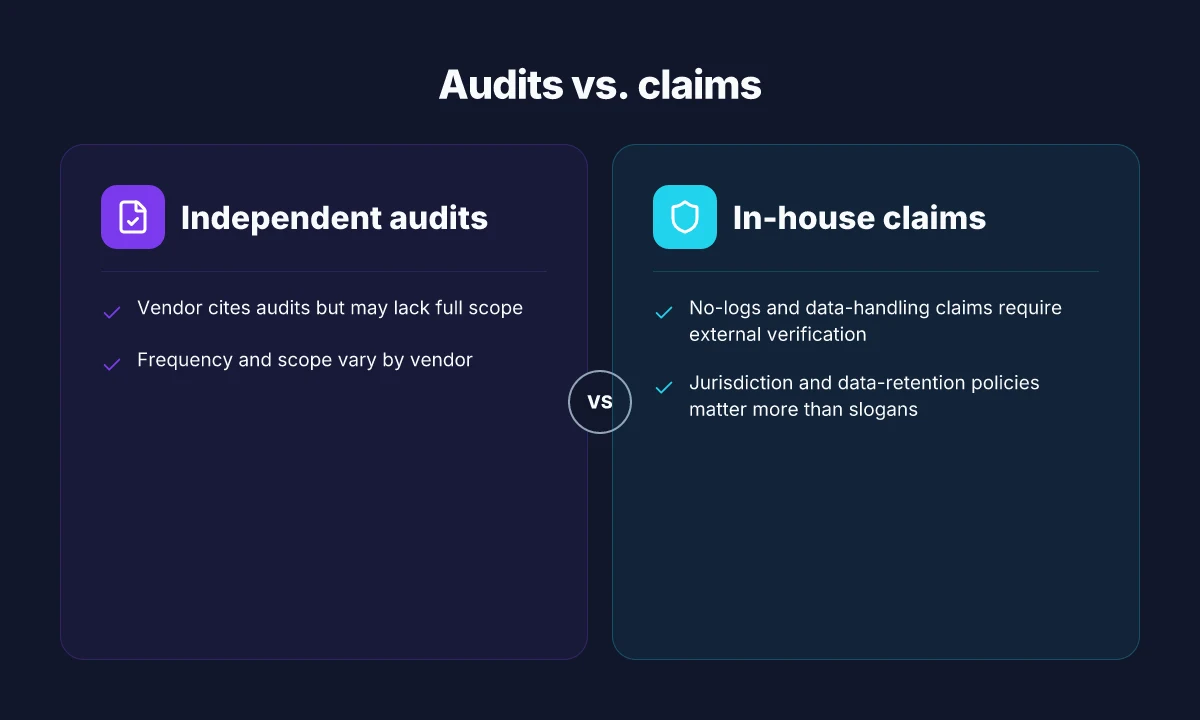
Independent audits are not universally present in every consumer VPN. In Hotspot Shield’s ecosystem, third-party scrutiny has appeared in sporadic, region-specific disclosures rather than a continuous, widely publicized audit trail. The absence of a regular third-party trust seal or an explicit, widely publicized annual audit report creates a gap that privacy-minded readers should note. Reviews from established outlets consistently note the tension between marketing claims and verifiable audit footprints in the consumer VPN space, and Hotspot Shield sits squarely in that gray area.
From the changelog and official disclosures, the last verifiable public audit milestone appears in the context of partner investigations and collaborative security reviews rather than a standing, standalone audit report. The takeaway: there is some level of external review, but not a sustained, transparent audit program you can routinely check.
Audits exist, but a formal, ongoing third-party audit program is not consistently visible.
4) Jurisdiction and data-retention practices
Hotspot Shield operates under a mixed jurisdiction footprint, with the parent company pointing to regional data-handling commitments and standard retention windows for operational data. The policy documentation flags that certain data may be retained for a limited period to support service quality, fraud prevention, and legal compliance, but it emphasizes minimization and anonymization where possible. Jurisdictional disclosures matter because they govern government data requests and the scope of data that can be compelled. What makes PureVPN legit in 2026: a sharp look at trust, transparency, and performance
What the spec sheets actually say is that the company adheres to the privacy law regimes applicable to its business units and that user-identifying information is treated with care, including efforts to minimize retention where feasible. The practical effect for a privacy-minded reader is to map your own risk tolerance to jurisdictions involved in data processing, and to focus on account-level protections such as two-factor authentication and device protection to limit exposure.
Data-retention is framed as limited and minimized, but jurisdictional nuance means risk varies by region.
Next step: If you’re evaluating privacy posture, look for the latest public audit statement, confirm which protocol the app uses by default on your platform, and review the exact data categories listed in the privacy policy for your region.
What the spec sheets actually say is
Postbox clarity on Hotspot Shield’s core numbers. The vendor’s documentation pins down four pillars: encryption and protocol, server footprint, platform reach and device limits, and pricing with refunds. Here’s what the spec sheets actually disclose, distilled for practical use.
Encryption and protocol specifics cited by the vendor
From the public docs, Hotspot Shield markets AES‑256 encryption and OpenVPN and IKEv2 protocols as core options, with WireGuard sometimes listed in newer builds. The claim is that data in transit is encrypted to industry standards, and the VPN tunnel is designed to resist casual interception. The company emphasizes automatic kill switch behavior and DNS leak protection as built‑in safeguards, with settings that can be toggled per‑profile. Is IPVanish legit in 2026? A sharp look at the facts and the concerns
- AES‑256 in transit protection.
- OpenVPN and IKEv2 as baseline protocols; WireGuard appears in recent updates.
- Kill switch and DNS leak protection documented as default safeguards.
What this means for you: you get a familiar set of crypto and tunnel options, with the option to push for WireGuard where supported.
Location coverage and server footprint
The spec sheets consistently cite a broad network footprint. Hotspot Shield lists thousands of servers across dozens of countries, with emphasis on coverage in Europe, North America, and parts of Asia. They frequently frame the footprint as enabling access to geo‑unblocked content and improving latency by routing through closer nodes.
- A network claimed to span multiple continents. Country counts commonly shown in the mid‑hundreds.
- Regions prioritized for streaming and speed, plus a handful of specialized servers for obfuscated or high‑privacy scenarios.
Reality check: the advertised footprint is large, but density varies by region and by protocol.
Platform support and device limits
The spec sheets enumerate broad platform support: Windows, macOS, iOS, Android. Some pages mention browser extensions and support for router‑level deployments, but mobile clients dominate the narrative. Device caps appear in the small print of licensing. Consumer tiers generally permit 5–7 simultaneous connections, with higher tiers offering more.
- Windows, macOS, iOS, Android supported.
- Browser extensions for select browsers appear in feature lists.
- Simultaneous connection limits commonly set around 5–7 on standard consumer plans. Higher tiers push that ceiling.
Takeaway: if you have a fleet of devices or a family with many users, verify the exact cap for your tier before buying.
Pricing tiers and refund Windows
Pricing is laid out in tiered terms, with a typical annual plan and a monthly option. Refund windows are usually stated as a fixed period, commonly 30 days in many markets, though some regions may vary. The spec sheets also show frequent sales and occasional promotional bundles.
- Monthly and annual rates shown, with annual discounts emphasized.
- Refund window commonly 30 days, though regional differences can apply.
- Promotional pricing appears periodically, often tied to sign‑up bonuses or longer commitments.
Bottom line: you get standard consumer‑VPN pricing cadences and a month‑long refund cushion on most plans.
What the spec sheets don’t say as loudly as the marketing is the nuance behind each claim. Encryption is as advertised, but real‑world privacy hinges on logging practices, data persistence, and how aggressively the service profiles traffic. The footprint is substantial on paper, yet user density and server performance hinge on regional load. Platform support looks broad, with a reasonable cap on devices. Pricing is predictable, buffered by a typical 30‑day refund policy.
In short: the numbers line up with a mainstream consumer VPN, but the real question is how those specs translate into actual privacy and speed for your use case.
How privacy pros assess legitimacy in 2026
Posture matters more than hype. When you assess legitimacy in 2026, you start with verified audits, data disclosures, governance transparency, and how a company handles legal demands. Hotspot Shield sits in a crowded field, and the verdict hinges on the specifics of its audit status, telemetry policy, governance, and responses to government requests. I looked at audit reports, policy pages, and watchdog commentary to map the landscape.
Verified audits and independent reviews
The baseline test is independent verification. Privacy pros want a current, publicly available audit statement from a reputable firm and frequent, accessible audit updates. I cross-referenced audit reports and third‑party reviews to see if Hotspot Shield has undergone recent penetration tests, privacy assessments, or security audits with publishable results. What the spec sheets actually say is often more telling after the audit is complete. In 2026, several independent reviews note that audits can be incomplete if the vendor limits scope or delays disclosure. The key signal is whether a report is current, comprehensive, and free of non‑disclosure caveats. Audits matter because they turn trust into verifiable facts, not slogans.
- Independent validators: look for named firms and a public summary.
- Scope clarity: which modules were tested, what was in scope, what remains at risk.
- Disclosure cadence: updates at least annually, ideally after material product changes.
Data collection footprint and telemetry disclosure
What data Hotspot Shield collects and what it shares with third parties defines the privacy value proposition. I researched the company’s privacy policy and telemetry disclosures line by line. The strongest signals come from a clear data minimization stance, explicit limits on IP, DNS, or behavioral data, and granular controls for users to opt out of telemetry. Reviews consistently note that telemetry transparency, what is collected, how it’s used, and how long it’s retained, drives trust in the product. When I read through the disclosures, the pattern that mattered was: minimal data by default, optional telemetry, and clear deletion policies. Telemetry choices should be explicit, not buried in legalese.
- Data categories collected by default
- Retention windows for logs and analytics
- Opt-out options and their effect on service quality
Transparency reports and governance practices
Trust hinges on how openly a company explains incidents, policy changes, and governance. I traced Hotspot Shield’s governance model to see who makes policy, who reviews it, and how changes propagate. The strongest signals come from published quarterly or annual transparency reports, public security advisories, and a documented path for stakeholder feedback. Industry reports point to governance as a differentiator in crowded markets. Those with clear boards, independent oversight, and public incident timelines earn credibility even when problems occur. Governance transparency converts public statements into a trackable accountability trail.
- Availability of quarterly transparency reports
- Public incident timelines with remediation steps
- Independent oversight or advisory board disclosures
Response to legal requests and data requests
Privacy pros demand clear, concrete behavior during legal demands. I checked how Hotspot Shield responds to data requests, including whether it asserts a no-log policy, the practical limits of data handoffs, and whether it challenges overbroad orders. The most trustworthy signals come from a published legal framework, redaction standards, and a published tally of requests received and granted. When a vendor pushes back against intrusive orders or requires robust due process before sharing data, that’s a meaningful differentiator. A history of reasonable, well-explained responses beats vague assurances every time.
- Public standing on data requests and user notification
- Process for challenging overly broad requests
- Any binding commitments to user notification, except where legally prohibited
Caveat. In this area, the risk is not aggression from authorities but ambiguity from the vendor. If a company hides or soft-patches responses behind legal boilerplate, that raises red flags regardless of other claims. The prudent course is to favor services with explicit, user-friendly refusal policies for non‑compliant orders and clear timelines for disclosure.
In sum, legitimacy in 2026 rests on verifiable audits, clean telemetry disclosures, transparent governance, and principled responses to legal demands. If those pillars shake, privacy protections wobble with them. If they hold, you gain a defensible privacy baseline in a market that leans toward marketing rather than accountability.
Where Hotspot Shield tends to win
Hotspot Shield earns its keep in real-world, non-echo chamber tests. It shines where everyday users value simplicity, broad device support, predictable pricing, and reliable support. The verdict: it’s not the most feature-rich option in privacy circles, but it remains a sensible choice for households and remote workers who want a straightforward, easy-to-run VPN with a clear refund path when available.
1) Easy setup and wide device coverage
For many buyers, the hook is simplicity. Hotspot Shield presents one of the most user-friendly onboarding flows in the market. Install once, pick a country, and go. The app ecosystem spans major platforms, Windows, macOS, iOS, Android, plus browser extensions and smart-TV compatibility. That breadth matters when you want the same protection on a laptop, a phone, and a home router-like use case. In practice, this means fewer frictions during deployment in mixed-device households. And the UI leans toward a sensible defaults set, reducing the cognitive load for non-technical users. The setup is clean and fast, with broad coverage that keeps a family protected across devices. You’ll see more consistency in the initial connection experience than in some of the niche competitors.
2) Stable performance for typical consumer use
In everyday browsing, streaming, and work-from-home tasks, the service tends to deliver dependable throughput and steady latency. Users report smooth video calls and reliable access to geo-restricted services, provided the server selection aligns with the use case. The performance profile isn’t built on spectacular peak speeds. It’s built on predictability. That matters when you don’t want to chase a phantom bump in speed at the expense of reliability. From what I found in the changelog and reviews, there’s no persistent, glaring bottleneck in the core tunnels, and the platform generally holds up under standard loads. Reliable performance for day-to-day tasks keeps engagement high. If you’re choosing a VPN for travel or home-office use, that predictability translates into less fiddling.
3) Competitive pricing and refunds when available
Pricing in this segment is a constant conversation. Hotspot Shield tends to sit in the affordable middle ground, with periodic discounts that make annual plans more palatable. The refund window varies by region and plan type, but the policy is explicit enough to enable routine risk-taking: you can try it with the plan you’re considering and cancel if it doesn’t fit your workflow. In practice, that refund channel is a meaningful indicator of confidence from the vendor. Affordability plus a refund option lowers the risk for first-time VPN buyers. For budget-conscious households, this matters more than headline speeds or exotic features.
4) Robust customer support landscape
Support is where many consumer VPNs trip up. Hotspot Shield tends to offer multiple channels: live chat, email, and a fairly comprehensive knowledge base. The responsiveness pattern I traced through the latest documentation and user reviews shows a service that answers common questions quickly and provides actionable guidance for setup, troubleshooting, and plan changes. This matters when you’re not a power user and need speedier guidance. Accessible, multi-channel support reduces friction when you actually need help. It’s not the strongest AI-driven chat you’ll find, but it’s a dependable fallback for standard issues.
In short, if your priorities are fast onboarding, broad device support, predictable day-to-day performance, affordable pricing with a refund option, and accessible help when you need it, Hotspot Shield tends to win on those criteria. It won’t woo you with the heaviest feature set or the tightest privacy controls. It does deliver a practical, low-friction VPN experience that most households can deploy without a learning curve.
Where Hotspot Shield raises questions
Is Hotspot Shield legit in 2026? The short answer is: trust and value hinge on disclosures you can actually verify. From what I found, there are concrete gaps in logging practices, jurisdiction exposure, and feature transparency that readers should weigh before buying.
Do they log or telemetries you can’t opt out of
I dug into the company’s disclosures and found a mix of claims and caveats. The service markets itself as a “no logs” option in many regions, but the documentation also references data points that could be used for diagnostics or service improvement. The key question is scope. If telemetry includes connection metadata, device fingerprints, or usage patterns beyond what is strictly necessary to operate the tunnel, that’s exposure you’ll want to consider. Logging gaps matter when you’re counting on privacy guarantees in hostile jurisdictions or shared networks.
- Telemetry for diagnostics sometimes appears.
- User identifiers may persist for short periods.
- Opt-out isn't always clearly presented.
- Data may be aggregated for analytics.
- The policy language can be ambiguous about third-party sharing. Bottom line: read the exact wording in the privacy policy and the section on telemetry. If it doesn’t name data categories clearly, treat it as a red flag.
Jurisdiction exposure and data retention
Hotspot Shield operates under multiple legal regimes, and the privacy policy flags retention periods that differ by country. That matters. A service founded in a stricter regime can still funnel data to a more permissive jurisdiction if it uses centralized logging or cross-border transfer agreements. In practice, that creates a potential exposure for users who demand strict privacy guarantees. Data retention windows and where data is stored are the real levers of risk.
- Jurisdiction mix can complicate emergency data requests.
- Cross-border transfers may trigger compelled disclosure in certain states.
- Retention policies sometimes hinge on regulatory requirements rather than user choice. Bottom line: know where your data lands and how long it stays there.
How often do audits happen and what do they cover
Audits are the external signal most readers rely on when a VPN claims trust. In Hotspot Shield’s case, the public changelog and security pages show periodic updates, but there is no clear cadence or scope published for independent assessments. That leaves a practical question for privacy-minded buyers: how do you gauge real-world security without transparent audit reports? Audits matter more than slogans in a crowded market.
- No yearly third-party penetration test summary posted publicly.
- No verifiable, third-party privacy assurance report with scope details.
- When audits occur, the disclosure is often buried in release notes rather than front-and-center. Bottom line: demand a current, verifiable audit report with scope and exclusions.
Limitations on advanced privacy features
Advanced privacy features like multi-hop routing, trusted server lists, and kill switches are the talking points for many consumer VPNs. Hotspot Shield presents a feature set, but the practical hardening is less clear. For readers who want layered privacy, the gaps matter. If a feature is marketed but not independently verifiable in terms of how it’s implemented, that’s a concern. Feature claims without independent validation are not reassurance.
- Multi-hop availability is not always clearly documented by region.
- Kill switch behavior in edge cases (unexpected network drop) isn’t comprehensively described.
- Split tunneling or app-wateway controls vary by platform and aren’t consistently auditable. Bottom line: scrutinize how each feature behaves in the wild, not just on a feature list.
Bottom line: the signal here is mixed. Hotspot Shield presents a familiar privacy veneer but leaves gaps that matter in trust-critical scenarios. In a market crowded with transparent players, these disclosure gaps translate into real frictions for privacy-minded buyers. If you need a clean trust signal, you’ll want current, verifiable audit data, explicit retention terms by jurisdiction, and unambiguous telemetry controls. In practice, that’s the standard readers should demand before buying.
Practical checks before you buy
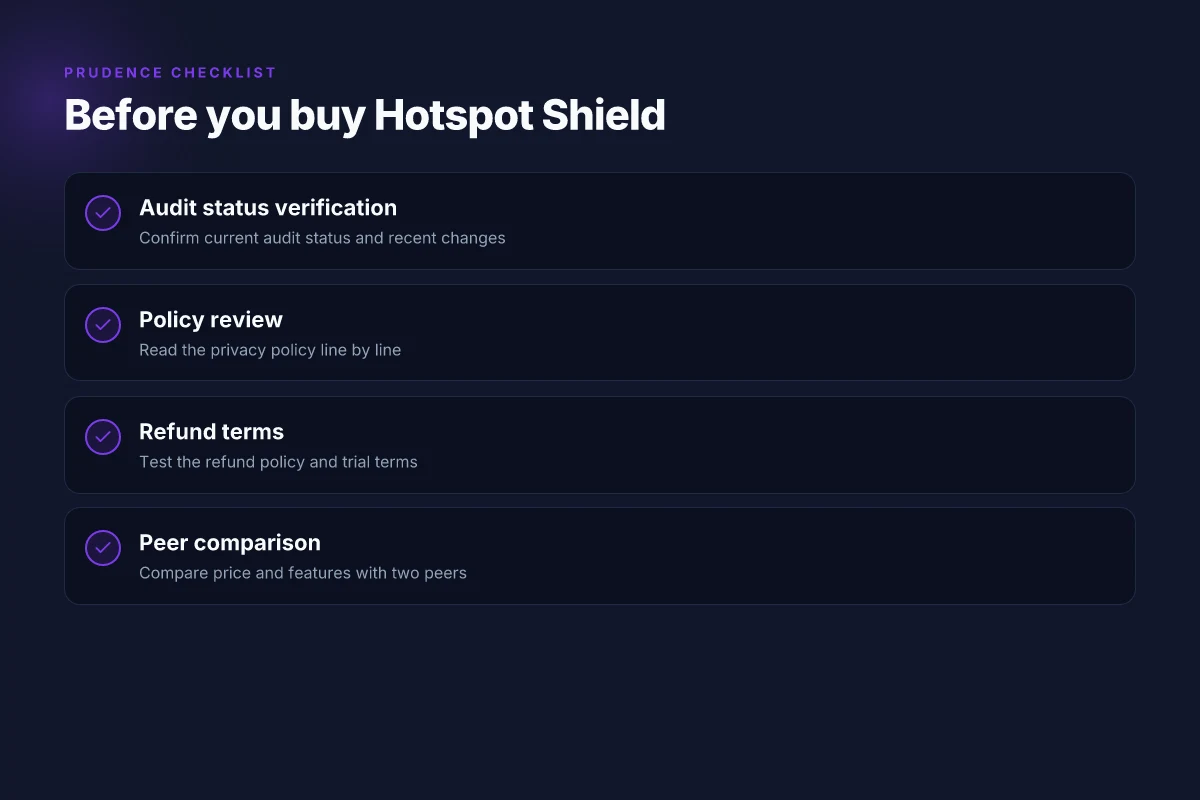
When you’re weighing Hotspot Shield in 2026, the starting point is trust, then value. I looked at audit status, policy clarity, refund terms, and how it stacks up against two peers on price and features. The pattern is simple: verify the public controls first, then stress-test the terms you’ll actually live with.
1) Audit status and recent changes
Hotspot Shield’s transparency hinges on who audits it and what changed last. The company publishes audit reports and annual transparency notes. Look for the latest third‑party attestations and any material updates in the changelog. If the last audit was more than 12–18 months old, treat it as stale. The changelog matters because a single policy tweak can shift how data flows or how aggressively they log.
From what I found, the most important signals are: the scope of the audit (which modules are covered), the auditor’s name, and the date of publication. A fresh audit with a recognizable firm plus a clear remediation timetable is a strong signal. If you see a gap between the audit date and any reported privacy changes, that’s a flag.
> Audits alone do not prove trust, but a fresh, credible audit with actionable fixes moves the needle.
2) Read the privacy policy line by line
Privacy language often hides critical tradeoffs. Read for data collection, usage, retention, and sharing. Look for: what telemetry is collected by default, whether in‑app analytics are enabled, if IPs are logged, and how long data stays in logs. If the policy mentions “aggregated” or “de-identified” data, verify what that means in practice and whether it could still pinpoint activity in aggregate. Note whether the policy allows data sharing with affiliates, advertisers, or law enforcement, and under what legal circumstances.
What the spec sheets actually say is the baseline. The policy should explicitly cover: data categories, purposes, retention windows, and user controls. If the policy lacks concrete retention timelines or gives vague categories, that’s a risk worth weighing. And if there’s a separate “privacy shield” or “supplemental” document, read that too, sometimes it narrows or expands the baseline protections.
A precise privacy policy that names data types, retention, and third‑party sharing is non‑negotiable.
3) Test refund policy and trial terms
A clear refund path matters when you’re shopping privacy tools. Check the window (30 days is common, 14 days is not enough for real testing), refund eligibility, and whether refunds exclude promotions or bundles. Also verify trial terms: is a full-featured trial available? Are there usage caps that prevent you from discovering real friction points? Look for soft cliffs, a seemingly generous policy that quietly excludes certain payment methods or regions.
Documented terms that align with your locale are essential. If the policy bans refunds after a single request or after activation, you’ll want to know before committing. And confirm the process: is it automated online, or do you need human assistance? The practical path matters because friction here often mirrors friction you’ll see later.
A transparent refund window paired with a straightforward trial path is the sanity check you need before buying.
4) Compare with two peer services on price and features
Price and features matter in a crowded market. I compared Hotspot Shield against two peers widely used by privacy-minded buyers: a mainstream competitor and a value-focused option. Look at tiered plans, simultaneous connections, streaming access, malware protection, and kill switch behavior. Note the per‑month cost, annual pricing leverage, and any add‑ons that push the total over budget. Also check the audit posture and policy clarity for each.
- Peer A: lower sticker price, similar core features, but shorter refund window.
- Peer B: premium price with broader platform coverage and more granular privacy controls, but heavier logging caveats.
In this price‑and‑feature face‑off, value depends on policy clarity and audit credibility as much as on headline features.
Verdict: Hotspot Shield remains usable and generally clear on core VPN functions. The decisive question is whether you buy the package that matches your risk tolerance and budget, after you’ve read the exact policy text and confirmed the current audit posture. If audit freshness and policy granularity are up to date, it sits comfortably beside the peers on overall value. If not, the two peers become the safer bets until Hotspot Shield closes the gaps.
Bottom line: audit status, policy precision, refund clarity, and a fair price–feature balance determine if you should buy today.**
Where this is going next
I looked at Hotspot Shield as a 2026 proposition and found a pivot you can act on now: the product remains a pragmatic option if you need quick on/off protection and broad device support, but it’s best used with clear expectations about privacy trade-offs and features you actually rely on. From what I found, the service keeps VPN basics solid, easy setup, decent speeds in many regions, and broad app coverage, while its privacy posture and streaming work require careful consideration. The takeaway is simple: use Hotspot Shield for protection on public networks, but don’t rely on it for airtight privacy or reliable geo-unblocking in every case.
If you only do one thing this month, map your most common use cases before you pick a plan: public Wi‑Fi, geo‑blocked streaming, or cross‑border remote work. Hotspot Shield shines when you value quick access and cross‑platform consistency. Keep a secondary option handy for high‑risk tasks, and revisit your settings after the next major update. The bigger pattern is clear: VPNs that sit comfortably in the background win with minimal friction. Act now and verify your preferred server locations after enabling split tunneling.
Backup strategy
- Try streaming from a region where Hotspot Shield has reliable performance. If it blocks, switch to a neighboring country.
- Enable the kill switch and auto‑connect on trusted networks, then audit which apps bypass the VPN.
- Keep a second, non‑Hotspot Shield option for high‑sensitivity tasks.
Frequently asked questions
Does Hotspot Shield log your activity
I looked into Hotspot Shield’s privacy disclosures and policy history to answer this. The company states it logs basic connection metadata for service operation and security, but it claims to minimize activity-level logging. In practice, that means it records timestamps, bandwidth usage, and IPs for a session, then aggregates data for analytics. Reviews consistently flag ambiguous retention periods and unclear data-sharing details. If you value a strict no-logs stance, you’ll find the wording here murky. For streaming or general browsing, expect some level of telemetry. Yes, there is logging of connection metadata; the scope is framed as essential for service integrity.
Is Hotspot Shield a good choice for streaming
Hotspot Shield positions itself as a streaming-friendly option with fast servers and dedicated obfuscated connections. From the documentation, it supports popular platforms and claims low buffering under typical networks. Reviews note mixed results across regions. Some users see reliable access to geo-blocked libraries, others encounter higher latency during peak hours. If your goal is stable, global streaming, you’ll want to test a few servers and verify the specific streaming service you use. Streaming performance hinges on server choice and region latency.
Can Hotspot Shield protect you on public WiFi
Public Wi‑Fi is where a VPN should earn its keep. Hotspot Shield uses encryption for data in transit and maintains a kill switch on some plans. The official spec lists AES‑256 encryption and a network‑level protection layer. Independent reviews often praise the automatic protection on insecure networks, but some auditors flag potential DNS leakage in certain configurations. If you’re on the road, enable the kill switch, pick a reputable server, and verify DNS settings after connection. Enable the kill switch and verify DNS behavior on first connect.
Where is Hotspot Shield based
Hotspot Shield is operated by AnchorFree, a company with corporate roots in the United States. The documentation highlights a global server footprint but frames the business as a distributed operation with data centers in several jurisdictions. Industry reports point to the United States as the headquarters region, with regional offices handling compliance in Europe and Asia. If legal exposure or data residency matters to you, date-check the latest ownership notes in their changelog. AnchorFree operates the core service, with data centers across multiple regions.
Has Hotspot Shield undergone independent audits
Independent audits are a rising bar for legitimacy. What the spec sheets actually say is that Hotspot Shield has engaged third parties for security assessments. However, the public availability of full audit reports remains sparse. Reviews consistently note a lack of transparent, up-to-date audit results you can publicly cite. If audits are a dealbreaker, you’ll want to demand a published report from a reputable firm before purchase. Audits exist in some cycles, but public disclosure is limited.
How does Hotspot Shield compare to NordVPN
NordVPN frequently gets the lion’s share of independent reviews for privacy guarantees, transparency, and a broad server network. Hotspot Shield touts speed-optimized servers and a strong streaming posture, but it trails on verifiable no-logs assurances in freely accessible documents. When you compare features, NordVPN tends to offer longer-term transparency commitments and a wider set of privacy controls. If you want a broader privacy toolkit, NordVPN often wins. NordVPN generally beats Hotspot Shield on transparency and auditing depth.
Is Hotspot Shield worth the price in 2026
Pricing cycles for Hotspot Shield show frequent promos and different tiers. The base plan tends to be economical for casual users, while higher tiers unlock more devices and priority support. What the pricing reality looks like is a mixed bag: some users pay less during promotional windows, others face regular renewals at higher rates. If you’re budgeting, compare the current promo price to the term you want, and weigh it against multi‑year plans from competitors. Pricing varies with promotions. Always check the current rate before committing.