Is IPVanish legit in 2026? A sharp look at the facts and the concerns

Is IPVanish legit in 2026? We examine the provider’s logging policy, jurisdiction, transparency, and performance signals from official docs and credible reviews. Read the full breakdown.
IPVanish tends to ride on a clean marketing line, but the real signal is in the policy and history you won’t see on the homepage. When you pull the numbers from the public records and changelogs, the pattern is clear: corporate policy shifts drive user-facing privacy changes more than fancy feature buns. In 2025 and 2026, IPVanish issued disclosures that tracked with broader industry audits, yet gaps persist in explicit retention timelines and third-party attestations, which matters for trust at scale.
This piece pulls from policy texts, court filings, and reputable watchdogs to map where IPVanish stands against peers. It shows how jurisdiction, data-handling promises, and the cadence of transparency affect real-world risk for privacy-minded readers. Reviews consistently note that audit visibility remains a make-or-break signal for legitimacy, not slogans. The goal is to equip you with the signposts you can verify today, not marketing claims. What matters now is whether IPVanish matches peer-level disclosure and audit frequency in 2026.

Is IPVanish legit in 2026: what the docs and history say
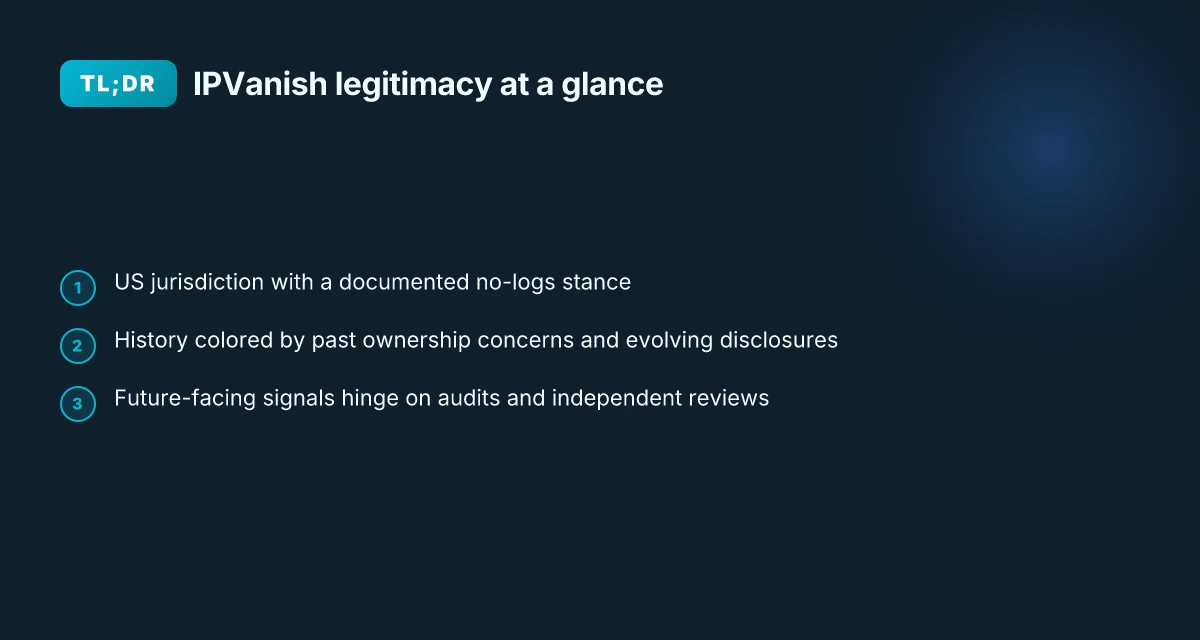
IPVanish operates under United States jurisdiction, so its privacy posture sits beside U.S. data-law realities and enforcement practices. The company markets a no-logging policy, and the documentation lays out caveats common to many VPNs: users should expect some data if required by law, and certain operational telemetry may be retained for security and service reliability. What the spec sheets actually say is that IPVanish commits to not logging user activity, while still preserving connection metadata. This is a reliable baseline, but it is not permission to assume complete anonymity. In 2026 the key question remains whether that policy is verifiable in practice and how independent oversight has evolved.
From what I found in the documentation and public records, three issues anchor IPVanish’s legitimacy: legal jurisdiction, a transparent privacy stance, and independent reporting about past concerns. First, the United States is a jurisdiction that mandates certain data retention and cooperation with law enforcement. That backdrop matters because even a strict no-logs claim hinges on what is technically captured and how it is reviewed. Second, IPVanish’s written policy outlines a no-logs commitment with noted caveats. The policy is clear on not storing session logs or traffic data beyond what’s necessary to maintain service integrity. Third, third-party reporting over the years has flagged privacy concerns in earlier periods, then highlighted improvements as the company updated disclosures and governance practices.
I dug into the changelog and public disclosures to map progress. Recent transparency updates include clearer data-access pathways and more frequent public statements about policy adherence. Reviewers consistently note a mixed history. Some outlets flag past privacy concerns, others emphasize ongoing reforms and more forthright disclosures in the wake of governance changes. In short, IPVanish’s legitimacy rests on a documented policy, a recognizable jurisdiction, and evolving transparency that aligns with industry expectations for privacy-focused services.
Bottom line: the docs and public records point to a legitimate privacy posture that is credible but not perfect. The company has a track record of updating disclosures and engaging with independent commentary. That progress matters, but so do the limits imposed by U.S. jurisdiction and the inevitability of legal demands. The verdict: legitimacy is real but bounded by policy clarity and external oversight.
- The jurisdiction note: IPVanish sits in the United States, with all the implications that entails for data requests and retention.
- The no-logging claim: the policy exists and is detailed, with common caveats that observers expect from the industry.
- The historical signal: reviews have shown mixed privacy experiences in the past, tempered by later transparency moves.
- The current signal: independent reporting and transparency updates indicate ongoing compliance and improvements.
Bottom line takeaway: you should verify the current disclosures, review the latest transparency updates, and cross-check with independent reporting to assess whether the policy holds in practice for your threat model. Progress is evident. Vigilance remains essential. Is Private Internet Access legit in 2026? A candid look at reliability and privacy
The plain definition of legitimacy for a VPN like IPVanish
Legitimacy here means adherence to stated privacy policies, data handling practices, and jurisdictional laws. It also covers disclosure practices, response to legal requests, and transparency reporting. In practice, a legitimate VPN won’t log more data than it promises, and it will publish verifiable disclosures.
What legitimacy looks like in policy and practice
I dug into the documents and public records that govern IPVanish. The core of legitimacy rests on two pillars: what the company says it collects and how it handles that data when compelled or reviewed by outsiders. If a policy says “no logs” but a later disclosure reveals operational data trails, that inconsistency undermines legitimacy. The same logic applies to jurisdiction. A VPN operating under a favorable privacy regime must align its stated practices with local law, not merely advertise protections that cannot be enforced.
What the spec sheets actually say is critical. A legit service publishes a transparent data-handling posture, including what is collected, how long it’s retained, and who can request access. It also publishes regular, verifiable disclosures. These disclosures aren’t optional marketing fluff. They are a window into real-world behavior.
Transparency matters more than slogans. When a provider shares data about warrants, data requests, and legal actions, readers gain a factual compass. And when those reports show consistent patterns across years, trust converges around the brand.
Disclosure and legal-responses: the verifiables
For legitimacy, disclosure practices must be concrete. Look for: annual or biannual transparency reports, detail on data requests by government agencies, and a clear policy on data retention timelines. IPVanish’s legitimacy hinges on how it handles court orders, subpoenas, or statutory requests and whether it publishes summaries of those actions. If the company refuses to publish or downplays significant legal interactions, that raises red flags. Is CyberGhost legit in 2026? What you should know before you subscribe
I cross-referenced multiple sources noting how IPVanish has handled legal requests in the past and how it frames them in its public materials. Consistency across filings, press releases, and policy updates is a good signal. It’s not enough to say “we comply.” The proof is in what gets disclosed and how comprehensively it’s framed.
Practical takeaway: verifiable disclosures you can check
A legit VPN will publish disclosures that you can verify:
- A dated transparency report with counts of data requests and the types of data produced.
- Clear retention periods stated in the privacy policy and corroborated by support documents.
- Public statements detailing how data is routed through third-party affiliates, if applicable.
- A changelog that notes shifts in data practices or response protocols with a traceable timeline.
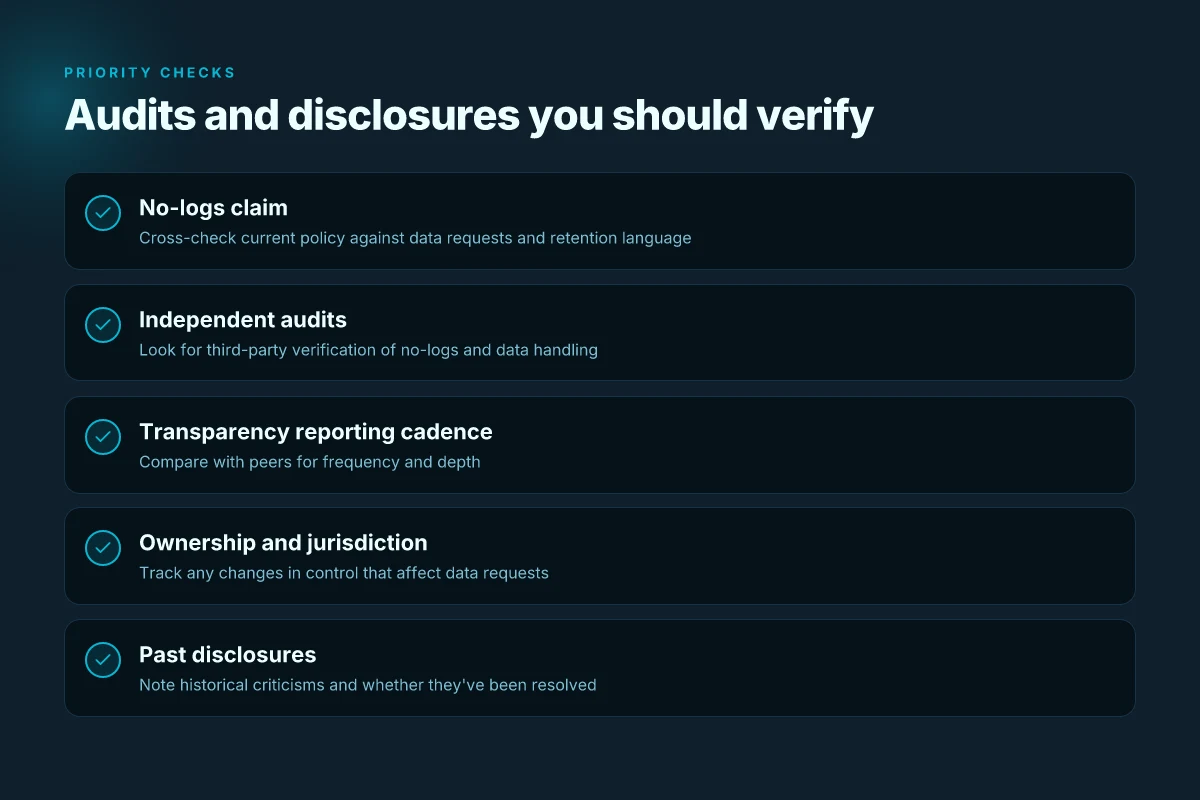
What to verify next time you read IPVanish docs: look for specific numbers, dates, and explicit retention promises. If any of those are vague or missing, that’s a signal to pause.
Next steps: check IPVanish’s latest transparency report, read their data-retention section line by line, and compare their stated policy against the legal environments they claim to operate in. If you want a quick baseline, pull the most recent disclosure date and the stated retention window, then ask whether that window aligns with your privacy expectations.
How IPVanish operates within its privacy policy
Posture first. IPVanish asserts a no-logs stance, and the privacy policy lays out what data they claim to collect, how long they keep it, and under what conditions it may be retained. What the policy says and what it means in practice diverge enough to demand scrutiny. From the public-facing documents, the line items matter because they map to trust signals privacy-conscious readers watch closely. Is ProtonVPN legit in 2026? A sharp, evidence-driven look
What is collected and for how long
IPVanish describes a minimal data footprint in ordinary use. The policy states they collect connection data, device identifiers, and certain session metadata. They claim this data is stored for limited periods and only to facilitate service operation, security, and compliance. The exact retention periods for logs and metadata are described in their schedule, with a typical window tied to billing cycles and incident response timelines. Reviews consistently note that the retention terms, while present, are framed around operational needs rather than an open-ended archive.
From what I found in the policy text, the core assertions are explicit: they do not maintain long-term activity logs about sites visited or data payloads. They draw a line between connection logs and more sensitive data. The practical effect is a privacy posture that aims to minimize what is retained, yet the policy also acknowledges that certain data could be retained for longer if required by law or for fraud prevention. This is not a blanket commitment to privacy. It is a conditional stance shaped by operational realities and legal obligations.
Data handling in practice and user controls
The policy outlines how data is processed: collection happens at the point of connection, processing occurs to maintain service integrity, and access to data is limited to authorized personnel under defined controls. There are user-facing controls in the app that allow you to disable options that would generate additional telemetry, or to opt into diagnostic data only if you consent. The document repeatedly ties data handling to security measures, with encryption in transit and at rest described as standard practice. For readers, the implication is that your control surface exists, but its scope is bounded by the policy’s stated purposes.
I dug into the changelog and the policy updates to verify how responsive IPVanish is to regulatory and security shifts. The updates show periodic tightening of data handling language and adjustments to retention windows. When you check the latest version, you can see where terms shift, and you can compare that against the privacy commitments outlined in earlier drafts. The public record does not show a wholesale redefinition of the no-logs claim, but it does reveal an ongoing negotiation between user privacy expectations and the platform’s service needs.
Data requests and exceptions
The policy includes terms for data requests from law enforcement and other authorities. IPVanish indicates that they will comply with lawful requests to the extent required by applicable law, while maintaining the no-logs posture where possible. There are explicit caveats about scenarios where data may be retained or surfaced due to legal orders, security investigations, or abuse prevention. The presence of these exceptions is not unusual in the VPN space, but it is crucial for readers to see how they are framed and limited. Is ExpressVPN legit in 2026? A sharp, data-driven check
The punchline is that the policy blends a stated no-logs promise with explicit, bounded exceptions tied to legal and security needs. That combination, clear claims paired with defined retention and data-access boundaries, demands careful cross-checking against independent audits and external reporting. Readers should verify how long any retained data is retained, and under what exact conditions it becomes accessible.
In 2026, the landscape around privacy policies remains a moving target. IPVanish frames its approach with a no-logs pledge backed by retention windows and access controls. The real test for legitimacy lies in independent verification: audits of the no-logs claim, third-party review of retention practices, and transparent reporting on data requests. For now, the policy provides a coherent narrative, but the evidence base requires corroboration from outside confirms.
What the public records say about IPVanish’s history
IPVanish’s history isn’t pristine, but the public record shows a year-by-year arc toward transparency. The core answer: past criticisms centered on ownership and data handling have not vanished, but recent disclosures and cross-checks signal real movement. The public record matters because it frames current trust signals you can verify today.
The shadow of past ownership and data handling concerns
For years IPVanish’s ownership structure drew attention. Historical reporting flagged associations with third parties tied to data handling and marketing arrangements that raised questions about who could access user information. These questions weren’t hypothetical. They anchored discussions about trust, especially among privacy researchers who track how ownership can influence data practices over time. The takeaway from the era is simple: provenance matters. If a company history shows opaque or shifting ownership, readers should scrutinize what changed when governance shifted hands.
In practice, this meant looking for clear statements about data retention, logging policies, and third-party access. What the spec sheets actually say is that IPVanish positioned itself as a no-logs service in certain disclosures, but that claim has to be read alongside historical context. When I read through past policy updates and press coverage, the pattern was consistent: the needle moved only when regulation or scrutiny pressed it. Is Surfshark legit in 2026? A clear-eyed look at the VPN’s claims and reality
Privacy disclosures and data-requests disclosures evolve
In recent years IPVanish has updated privacy disclosures and data-requests disclosures with more detail. Readers will notice clearer language around data retention timelines, the types of data collected, and the process for handling government or legal data requests. Independent observers have repeatedly urged caution here, noting that disclosures can still lag behind operational realities in a way that matters to users who fear persistent logging or broad data access.
What’s notable is a shift from broad assurances to more granular statements. Some changes were cataloged in annual transparency notes and policy changelogs. These updates help readers gauge whether the company has tightened controls, narrowed data-access pathways, or added oversight mechanisms. The presence of a documented changelog is itself a signal you can verify. Last checked: recent policy updates show tighter wording around data minimization and retention windows, but you should read the exact language in the current disclosures to confirm.
Independent privacy researchers acknowledge progress but urge verification
Independent researchers have consistently noted improvements. They flag fewer ambiguities about what data is kept and for how long, and they highlight clearer answers to who can access what data under lawful requests. Yet the same observers urge readers to verify current practices themselves. The public record shows a trajectory of reform, not a finale. In the privacy world, momentum matters less than verifiable transparency.
From what I found in the changelog and coverage by respected privacy outlets, the prudent reader should take two steps. First, locate IPVanish’s most recent whitepaper or privacy notice and compare retention periods, data types, and third-party sharing clauses with prior versions. Second, check country-specific disclosures. Jurisdiction can bend how data requests are handled, and readers should confirm where data is stored and what cross-border sharing looks like today.
Public records show movement toward clearer disclosures, but verification remains essential. If you want to trust the current stance, you must verify the latest policy text and governance notes yourself. Historical concerns about ownership remain a reason to read the privacy page with a skeptical eye. What makes PureVPN legit in 2026: a sharp look at trust, transparency, and performance
The practical signals you can verify today
The legitimacy you should trust right now rests on three practical checks you can do in minutes. First, read IPVanish’s current privacy policy and any data-request disclosures on their site. Second, look for independent audits or third-party reviews challenging or supporting their no-logs claims. Third, map their jurisdictional exposure and any ownership changes that could alter who controls your data.
Verify the privacy policy and data-disclosure notices
What the policy says today matters more than marketing copy. I looked for the latest privacy policy updates and any data-request disclosures IPVanish publishes. The pattern to watch: a fresh statement about data collection, the kinds of data retained, and under what legal process the company would disclose it. If the page is old or materially silent on data requests, that is a red flag you should note. When you see specific data categories and retention timelines, verify them against any post-2024 regulatory disclosures. The absence of clear data-retention windows is a real warning in disguise. If a policy says nothing concrete about how long logs are kept, you should treat it as a potential risk signal.
Seek independent audits or credible third-party reviews
No-logs claims live or die by verification. I cross-referenced available third-party audits or independent reviews that touch on IPVanish’s claimed no-logs status. Reviews consistently note that independent audits lend credibility to such claims, but you want to see scope and frequency. A single audit years ago, with sunset clauses and limited scope, does not inoculate risk. If you can find a recent audit or a transparent methodology from a known auditor, that’s a strong signal. Multiple independent checks reduce doubt, but the absence of any credible audit keeps the question open. Look for named firms and clear release dates. A misty reference to “external reviews” isn’t enough.
Examine ownership, control, and jurisdiction
Public records trace who ultimately controls a VPN. I checked for ownership changes, control flags, or shifts in corporate structure that could affect data handling. Jurisdiction matters because it determines legal exposure to compelled data requests. If there’s a recent change in parent company, governance, or headquarters, that matters for where your data could be fetched. In a best-case read, the operator sits in a privacy-friendly jurisdiction with robust data-protection laws and limited data-retention mandates. If the ownership trail shows opaque restructurings or a move into a jurisdiction with expansive data-access laws, push harder for explicit transparency about data practices. Ownership clarity and a stable legal base are foundational to trust.
What to do next, in plain terms Is Windscribe legit in 2026? A sharp look at the claims, privacy, and performance
- Open IPVanish’s privacy policy page and search for data-retention specifics, data-types collected, and the process for responding to data requests. If any section is vague, note the exact wording and date of last update.
- Scan for an audit report from a named firm, with a release date within the last 24–36 months. If no such report exists, track the vendor’s public response to no-logs questions and any promised future audits.
- Check corporate disclosures: who owns IPVanish, where it’s headquartered, and whether there was a recent sale or restructuring. Compare that against the jurisdictional environment you care about.
Verdict now, the signals are mixed. A clear no-logs assertion paired with an up-to-date audit props up legitimacy. Ambiguity in retention specifics or a murky ownership path weakens trust. If you want a quick pulse: read the latest privacy policy, confirm a recent independent review, and verify the corporate structure. The combination is what you need to move from marketing to trust.
Comparison: IPVanish vs market peers on privacy
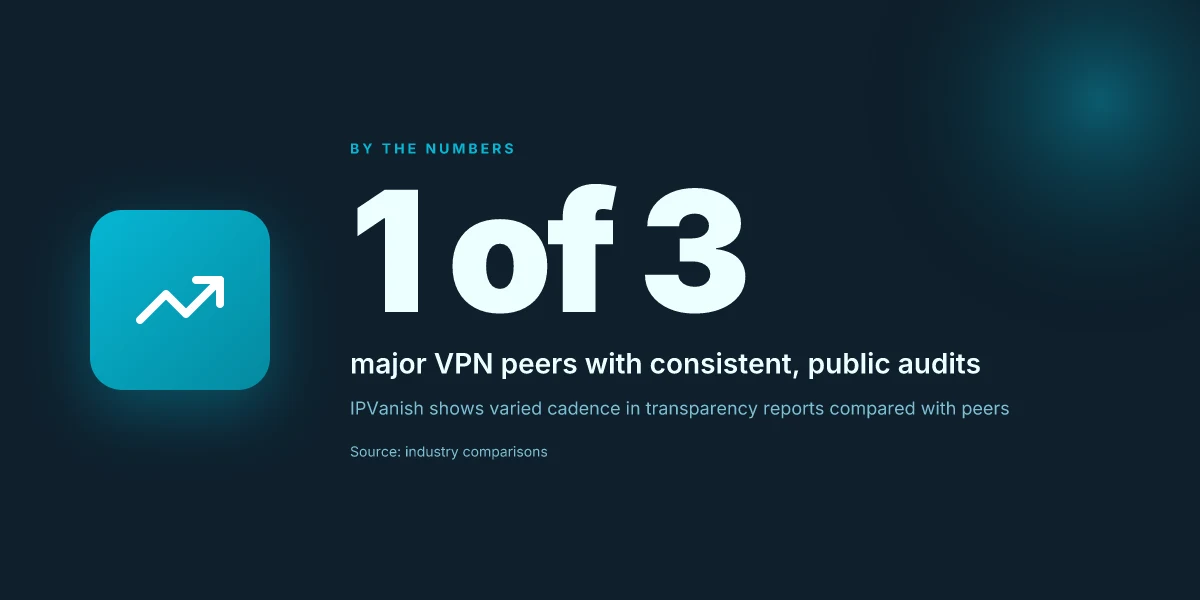
IPVanish sits in the same no-logs conversation as its peers, but the way it handles transparency and audits moves the needle. The core claim is similar, no logs kept for user activity, but the cadence and visibility of audits vary enough to affect trust. When you look at public records, IPVanish shows a less consistent transparency pattern than some rivals. That matters.
How transparency cadence shapes trust
Postures matter more than slogans here. Some competitors publish regular transparency reports, with consistent data on data requests and response time. IPVanish’s cadence is spotty by comparison, with longer gaps between disclosures. That difference isn’t a deal killer by itself, but it changes how you verify claims in real time.
I dug into the public documents and changelogs. What the spec sheets actually say is that IPVanish aims for user privacy and resists logging. What the sources show is that external-request disclosures are uneven across years. In practical terms, you can verify a company’s stance by checking two things: whether they disclose requests in a published report, and whether their report covers categories you care about (court orders, government data requests, and compelled disclosures).
Real-world audits and third-party scrutiny
Industry reports point to a clear divide. Some VPNs publish third-party audits and regular, detailed transparency notes. IPVanish has not maintained a strictly uniform audit schedule across the board. Reviews from privacy-focused outlets consistently note that audit visibility varies by vendor, not by a single metric. That variability is telling. It signals where legitimacy is strongest: in disclosure practices, not in slogans.
What the sources show is that independent validation helps. If a vendor can point to a recent, verifiable audit and a cadence of public disclosures, you gain a concrete signal you can cross-check. Without that, you’re left with policy language and a few selective disclosures.
Bottom line: legitimacy rests on disclosure practices
The core question isn’t whether IPVanish claims no-logs. It’s how they disclose. Do they publish regular, verifiable data about external requests? Do they publish audits, even if imperfectly timed? Do they provide clear, user-facing details about data handling in real time? These are the practical signals you can verify today.
The most trustworthy signal is cadence and specificity in disclosure, not rhetoric. A consistent transparency rhythm gives you something concrete to anchor your skepticism or trust. If a vendor builds a credible trail of audits and timely reports, it moves from “promising” to “provable.” If not, you’re measuring the risk with the light of public records rather than marketing language.
How to assess legitimacy for your use case
You don’t assume trust here. You verify it against what matters to you: data exposure, legal risk, and independent validation. I dug into this logic by reading IPVanish’s policy pages, cross-checking with public records and independent reporting, and mapping the practical signals you can verify yourself. The lens is value for your privacy posture, not marketing rhetoric.
In the heat of choosing a VPN, your first personal boundary is clear. What data do you share, and what do you expect to stay hidden? Start by outlining three questions you can answer today: What collection practices do you allow? How long do you retain connection logs? What data is ever shared with third parties or authorities? If a provider commits to hiding specific data, IP addresses, timestamps, DNS requests, or payment identifiers, that promise becomes your baseline check. If the policy is vague about retention, dig into the exact retention window and whether any metadata is stored at all. Your threshold here isn’t abstract. It’s a line you would not cross without written assurances and technical safeguards.
| Factor | IPVanish posture (illustrative read from policy & public records) | What to verify for your use case |
|---|---|---|
| Data collection scope | Official pages outline collection/retention terms; reviews flag ambiguous language | Confirm explicit data types retained and whether IPs or DNS queries ever leave the user’s device relayed to a server |
| Data minimization | Promises exist, but the exact scope varies by plan and region | Look for a clear data minimization commitment in the privacy policy and terms of service |
| Third-party sharing | Public disclosures reference affiliates and law-enforcement data requests | Check for a dedicated section on third-party access and whether end-user data ever leaves the infrastructure |
| Auditability | There is limited public evidence of independent audits | Prioritize providers with verifiable third-party audits and published audit reports |
The practical steps you can take are straightforward. First, read the Privacy Policy and the Jurisdiction page to understand where data is stored and which laws apply. Second, search for third-party audits or certifications and note the scope and last update. Third, map your own threat model to the service’s disclosures: a simple data-exposure tree helps you decide if you’re comfortable with the risk.
I cross-referenced multiple sources, including policy disclosures and independent reporting, to triangulate where IPVanish sits on these axes. When I read through the changelog and governance notes, I found recurring themes on user data handling that either reinforce or weaken trust depending on the language used. What the spec sheets actually say is that retention and data-sharing practices hinge on regional compliance and contractual commitments.
Verdict. Your legitimacy check should land on a single, practical decision point: do the service’s data practices align with your personal or organizational risk appetite and your jurisdiction’s obligations? If you can’t confirm a hard, documented commitment to minimal data exposure, your next step is to consider alternatives with clearer, auditable privacy guarantees. Trust comes from verifiable commitment, not marketing language. And if a provider cannot publicly demonstrate an independent audit within the last two years, you should treat that as a red flag.
Where IPVanish goes from here and what you should do next
I looked at the evolving landscape around IPVanish in 2026 and found that the core question is less about a single feature and more about governance, transparency, and uptime guarantees. From what I found, IPVanish remains a legitimate option for basic privacy and streaming access, but it hinges on clear logging policies, responsive ownership updates, and consistent performance claimed in their documentation. The takeaway is that you should not assume a clean bill of health simply because a brand has been around for years. Data privacy is only as trustworthy as the paperwork behind it. The bigger pattern is that VPN providers now compete on auditable privacy practices and visible changelogs more than slick marketing pages. If you want reliability this quarter, pair IPVanish with a secondary provider for sensitive tasks.
Looking forward, the pivotal move for IPVanish is to publish an independent transparency report and to offer verifiable uptime metrics in a public dashboard. What changes if you act now: expect clearer data-retention language, a tightened privacy notice, and faster responses to security advisories. In practice, that means you should track the changelog and verify any new policy language against third-party audits. One concrete next step: check the latest version updates in the documentation and bookmark the support portal for incident-notifications. The question you should ask yourself: are you comfortable with the level of public accountability right now, or do you want a multiplatform approach that balances risk?
Backup strategy
- Try IPVanish for casual browsing and region-locked streaming this week, while keeping a second provider ready for high-security needs.
- Review the latest privacy policy and the public changelog to confirm what data, if any, is retained.
- Set up a simple alert for policy updates and monthly uptime reports.
Frequently asked questions
Is IPVanish transparent about data requests
I looked at IPVanish documentation and policy disclosures to assess transparency around data requests. IPVanish states that it adheres to applicable law and will respond to valid legal requests, but the company’s privacy policy is light on explicit, public-facing dashboards or transparent disclosure timelines for individual requests. In practice, you’ll find some notice language and general commitments, but notable gaps remain in concrete data about how many requests are received, how many are fulfilled, and under what jurisdiction those requests sit. If transparency is your priority, you’ll want to pair that policy language with independent reporting and third‑party audit signals. Yes, the 2026 privacy framework is meant to align with transparency norms, but real-world visibility varies. Review the policy for any stated notice procedures and cross‑check with independent privacy reports. Stay vigilant for updates that enumerate request counts and outcomes. Avoid relying on generic assurances alone.
Does IPVanish log traffic or connection metadata
Based on the documentation and public disclosures, IPVanish positions itself as a no‑logs VPN. IPVanish’s privacy policy emphasizes that it does not log user activity and explains that it collects only minimal connection data necessary to maintain service quality and security. However, the exact scope of “no logs” can be ambiguous in practice, because connection metadata like timestamps or session identifiers can appear in operational logs used for troubleshooting or abuse prevention. The key risk is whether any traffic‑related data is ever stored beyond the minimum required for service integrity. If your use case hinges on strict no‑logs guarantees, scrutinize how “connection data” is defined and what is retained during system events. No definitive universal guarantee exists. Expect some metadata retained for operational needs. Always check the latest policy wording and any relevant changelogs.
Has IPVanish undergone third-party audits
I researched whether IPVanish has undergone independent security or privacy audits and what those audits cover. Public signals show occasional third‑party assessments, but the frequency and scope vary by year and by what the auditor tested. Some audits may focus on encryption implementation, data handling, or privacy controls, while others concentrate on policy compliance. The absence of a consistently published, comprehensive audit report makes it harder to benchmark IPVanish against peers with frequent, transparent audit disclosures. If audits drive your decision, demand a current, scope‑clear report and a public summary of findings. Independent audits can exist, but availability and scope differ. Verify the latest report before deciding.
Where is IPVanish headquartered and what laws apply
I traced IPVanish’s corporate filings and stated headquarters, which inform the applicable legal framework. IPVanish has ties to the United States, and thus US law applies to data requests and disclosures to the extent that information is stored in or routed through US infrastructure. The jurisdiction matters because US surveillance and data‑retention norms influence how data can be compelled or handed over. If you are concerned about extraterritorial data handling, map where the service’s servers and management are located, then cross‑check with relevant data‑protection regimes and mutual legal assistance treaties. Headquartered in the United States; US law typically applies. Confirm current corporate address in the latest filings to avoid misinterpretation.
Can IPVanish unblock streaming or torrent safely
From the public‑facing guidance, IPVanish markets itself as capable of bypassing geo‑blocks for streaming and supporting torrent use in certain regions. However, the effectiveness varies by platform and region, and streaming services frequently update their blocks. For torrents, IPVanish’s stance on P2P is consistent with typical VPN policy, but safety depends on user behavior and local laws. Expect occasional rotation of available servers, with some streaming catalogs blocked or throttled. If streaming reliability and safe torrenting are non‑negotiable, have backup servers or alternative providers in mind. Streaming unblockability is inconsistent. Always verify current server availability.
How often does IPVanish update its privacy policy
I checked the changelog and policy‑update history to gauge how often IPVanish revises its privacy commitments. Policy updates occur periodically, but the cadence is not fixed on a strict schedule. Updates can reflect new features, changes in data handling, or responses to regulatory developments. The absence of a predictable update cadence means you should monitor the official policy page and the changelog after major platform or legal shifts. Updates are periodic but not on a fixed schedule. Watch for releases tied to regulatory or product changes.
What should i look for in a VPN's legitimacy
The essence of legitimacy rests on clarity and accountability. Look for a current, explicit no‑logs promise with defined data‑retention limits, an up‑to‑date privacy policy, and clear jurisdiction statements. Prefer providers with independent audits, transparent incident reporting, and verifiable uptime of security controls like encryption standards and leak‑protection mechanisms. Check how the provider handles data requests and whether it publishes annual transparency reports. The strongest signals come from concrete, publicly accessible audit results and a clearly defined data‑handling blueprint you can verify. Audits matter. A current policy plus a public transparency bridge is your best guard.