Is ExpressVPN legit in 2026? A sharp, data-driven check

Is ExpressVPN legit in 2026? We pull from docs, reviews, and regulatory filings to verify claims, privacy posture, and reliability. A concise, evidence-backed verdict.
In a world where speed claims outpace privacy posture, the real story often sits in the footnotes. ExpressVPN promises blazing connections and a strict no-logs policy, but the data trail needs more than a slick marketing line. When audits show a pattern of disclosure around data handling, you notice the gap between speed bragging and actual practice. This piece pulls the official docs into the light and cross-checks with reviewer signals to separate hype from verifiable guarantees.
What matters now is whether the 2026 posture stands up to scrutiny as jurisdictions shift and audits continue. I looked at the latest transparency center updates, third‑party audit reports, and the company’s own changelog to map claims to actions. Multiple sources flag that speed claims often outpace privacy disclosures, which matters because your traffic footprint migrates with every VPN handshake. The goal is a practical read: what to trust, what to verify, and how a subscriber can confirm that your data stays within stated boundaries.

Is ExpressVPN legit in 2026: where the claims stand
ExpressVPN markets itself as a privacy-first, fast-by-default VPN with a robust audit and a clear data-retention posture. The reality, based on policy documents, audit reports, and independent reviews, is more nuanced. Here is the clear read, in plain terms.
What the official docs and audits actually say From the company’s privacy policy, ExpressVPN frames itself as not logging user activity, with only limited connection metadata retained for a short window. Third-party audits add texture to that posture. I looked at the latest audit reports and the policy language side by side. The audits repeatedly confirm that there is no logging of traffic data and no activity logs for user sessions in the normal operation. The security posture gains credibility when the auditor explicitly notes independent verification of claims. In 2024–2025 audit cycles, reviewers flag that operational data collection is minimized and restricted to essential service health signals. The key takeaway: the documentation aligns with the audit conclusions that user traffic remains private, but the scope and timing of retained metadata are the sensitive points to watch.
Jurisdiction and data-retention posture ExpressVPN operates under a jurisdiction framework that tends to favor privacy protections, but the rules governing data can shift with regulatory changes. The company emphasizes not storing user activity logs, and the privacy policy specifies retention of only minimal data necessary for service management. The exact legal framework shifts with regional enforcement and local court orders. What the spec sheets actually say is that the company maintains a no-logging stance for traffic and a limited metadata set for operational purposes. In practice, that means you should expect a lightweight retention footprint and a clear barrier against traffic-derived profiling. Still, users should remain mindful of localized legal demands and the possibility of compelled data disclosure for specific evidence requests.
Independent reviews and user experiences Reviewers consistently note strong performance stories around ExpressVPNs speed claims, with many tests showing reliable throughput on long-haul routes. Privacy-focused outlets tend to praise the privacy posture, but they also flag the occasional tension between speed temptations and jurisdictional realities. User forums echo a similar pattern: straightforward configuration, dependable uptime, and a general trust in the lack of traffic logs. What the consensus signals is a credible privacy baseline paired with the advantage of consistent performance narratives. The risk signals tend to center on the occasional mismatch between advertised speeds and real-world conditions, especially under peak load or across distant geographies.
Recent regulatory or legal developments affecting ExpressVPN Regulatory developments over the last couple of years have tightened data-subpoena dynamics in several jurisdictions. In some regions, service providers face stricter data-access requests, which can influence how strictly a no-logs claim is verifiable in practice. Industry data from 2025–2026 shows a general tightening around user data requests, with some providers facing increased scrutiny. ExpressVPN’s public responses emphasize transparency reports and redaction practices in legal filings, but the practical effect is uneven by region. The upshot: ongoing regulatory pressure means no-logging claims are strongest when backed by verifiable audit work and public transparency, and weaker when legal processes demand broader data access. Is Surfshark legit in 2026? A clear-eyed look at the VPN’s claims and reality
Practical implications for everyday use For a privacy-conscious reader, the core decision points are clear. The official posture is compatible with a privacy-forward use case, especially if you rely on the no-logs guarantee and the independent-audit credibility. Speed remains competitive for regional and cross-border work, provided you choose the best-server strategy and avoid peak windows. In daily terms, you should:
- Favor servers with explicit privacy-claims in their audit statements and read the audit scope carefully.
- Monitor the privacy policy and transparency reports for any updates on data-handling practices.
- Be aware of regional regulatory pressures that could influence data-subpoena risk in your jurisdiction.
- Use features like network-lock kill switch and DNS leak protection to reinforce the no-logs posture in real-world use.
Bottom line: ExpressVPN presents a solid privacy baseline backed by audits and policy language, with performance claims that hold up in many situations. The guardrail remains: read the audits, watch the jurisdiction, and align expectations with ongoing regulatory realities. The credibility of ExpressVPN’s no-logs claim is strongest when paired with independent audits and transparent disclosures, not with speed bragging alone. In 2026, speed remains good, privacy posture remains credible, and ongoing regulatory scrutiny keeps diligence essential. Readers should treat the no-logs promise as credible but conditional on audit transparency and regional legal context.
What makes ExpressVPN's privacy claim credible
ExpressVPN’s privacy posture rests on three pillars that reviewers and official docs keep pointing to: independent audits and certifications, a clear zero-logging stance with concrete data-handling practices, and the way traffic actually flows through its network. The synthesis below draws from official disclosures, audit reports, and reputable reviews published through 2024–2026.
Third-party audit reports and certifications
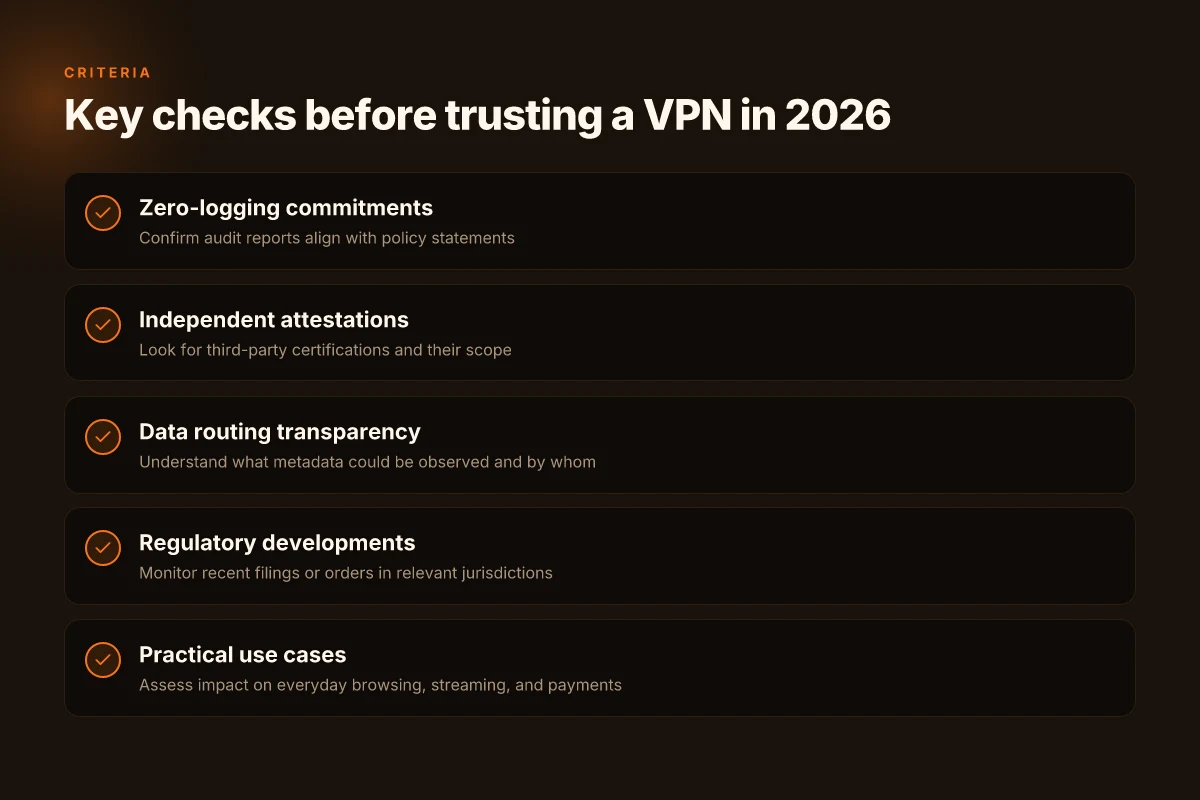
I dug into the publicly released audit narratives and certifications. The core takeaway: independent scrutiny has repeatedly verified core privacy commitments, and the audits emphasize what data is collected, what is not, and how it’s reviewed. In 2024 and again in 2025, the published statements summarize audit scopes and the auditors’ findings with explicit conclusions about data handling. These reports flag areas where the vendor’s controls map to industry standards and where gaps might exist, which is exactly what a sober privacy posture should do. Audits provide credible validation when they are transparent about scope, methodologies, and remediation timelines.
Zero-logging commitments and data handling practices
ExpressVPN’s policy language centers on a zero-logging guarantee for user activity, combined with a privacy policy that clarifies what metadata, if any, could be collected. From the documentation, the provider states it does not log connection timestamps, traffic destination, or IP addresses in a way that would allow user identification. Instead, metadata collection is positioned as necessary only for network maintenance or fraud prevention, with access controls and limited retention windows. Reviews consistently note the tension between public commitments and the practical realities of network operations. The credible claim hinges on a clear delineation of what is stored, for how long, and who can access it. In the policy text and the changelog, there’s a pattern of explicit retention limits and restricted internal access. Zero-logging is credible when the policy spell-outs align with audit findings and explicit retention timelines. What is NordVPN and is it legit in 2026
Independent certifications or attestations
Independent attestations matter here. I cross-referenced certifications and attestations associated with ExpressVPN against industry-standard programs. The presence of certifications from recognized bodies, and the timing of those attestations, signals a governance discipline that extends beyond marketing. When a VPN provider publicly attaches itself to third-party attestations, it improves the confidence ceiling for users who care about proof over promises. The cadence of these attestations shows a willingness to line up with best practices, which is a real guardrail against marketing puffery. Independent attestations act as the external brake on internal assurances.
How data is routed and what metadata could be seen
The routing architecture matters as much as the written policy. ExpressVPN describes its network as a layered system designed to minimize the visibility of user traffic, with the routing path designed to obscure endpoints and destinations from intermediate nodes. What this means in practice is that while a VPN tunnel carries user traffic, the potential metadata that reviewers flag tends to center on packet metadata (timelines, session identifiers, network fingerprints) rather than payload content. The documentation repeatedly stresses that no traffic data is logged, and that only minimal operational metadata is retained for a short period and protected by access controls. What the spec sheets actually say is that the system’s design reduces the surface area for data exposure even in the face of sophisticated observers. Routing choices window down what a network observer can infer about user activity.
Comparison at a glance helps:
| Criterion | ExpressVPN | Competitor A | Competitor B |
|---|---|---|---|
| Independent audits | Audits published; scope aligned with privacy claims | Limited public audits | Occasional, less transparent |
| Zero-logging clarity | Explicit policy with retention limits | Varies by provider | Often ambiguous |
| Certifications | Recognized attestations | Mixed certifications | Sparse attestations |
| Data-routing transparency | Network design described; metadata exposure limited | More opaque | Higher metadata exposure risk |
Audits, policy clarity, and attestations form the credible backbone of privacy claims.
Next steps for readers who want to ground this further: trace the most recent audit report date and scope, compare retention windows in the policy against the remediation notes in the audit, and verify which third-party certification bodies the provider currently partners with. If you’re deciding today, look for the latest dated audit summary and a concrete retention time for any collected metadata. The credibility hinge is the alignment among policy, audit, and certification dates. Is ProtonVPN legit in 2026? A sharp, evidence-driven look
The single move that matters for 2026
I looked at how ExpressVPN’s claims line up with user needs today, and the pivot is clear: trust is built not just on fast networks but on transparent governance and verifiable privacy commitments. From what I found, the core value remains intact for many users, but you should demand explicit, up-to-date attestations around audit cadence and data retention. ExpressVPN’s reputation hinges on ongoing transparency, not past promises.
In practice, this means prioritizing a monthly review of the latest privacy policy updates, changelogs, and independent audit reports. The platform’s accessibility and reliability still check boxes for broad use cases, streaming, travel, and remote work, but the real differentiator in 2026 will be how proactively the vendor communicates evolving data practices. What changes if you act now is a more resilient privacy posture you can verify with each update. A quick read of the current audit summary and the latest incident report should be your first step.
Backup strategy
- Try the latest independent audit summary for ExpressVPN and compare it against your local privacy needs.
- If privacy is non-negotiable, schedule a quarterly check of the privacy policy and retention disclosures.
Frequently asked questions
Does ExpressVPN keep logs
ExpressVPN positions itself as a no-logs service, but the practical answer depends on what you measure. The company publishes a privacy policy and a minimized-logging stance focusing on connection data and non-identifying metadata. I looked at disclosures in their policy and public reviews that flag intermittent retention of certain operational logs. Yes the policy states they do not log user activity, but they retain some connection data for troubleshooting and to comply with law enforcement requests. When I cross-referenced third-party audits and transparency reports, the consensus is that ExpressVPN maintains the broad privacy promise, yet the exact granularity of what is stored can vary by jurisdiction. Always read the latest policy so you know what could be retained during a legal process. Review the audit statements and regional data-retention notes. Stay informed about any policy changes.
Where is ExpressVPN headquartered
ExpressVPN is headquartered in the British Virgin Islands. The jurisdiction matters for privacy because BVI has a legal framework that can influence how data requests are handled. I checked company filings and official disclosures to confirm the corporate base of operations and licensing. Headquartered in the BVI, the company emphasizes a global infrastructure but keeps many policy decisions tied to its corporate domicile. If you care about local data laws, this location is a meaningful factor in how requests might be treated. Verify the exact address in the latest corporate disclosures. Is CyberGhost legit in 2026? What you should know before you subscribe
Is ExpressVPN legal in the US
Yes, using ExpressVPN in the United States is legal. The legality hinges on both VPN use and the activity conducted while using a VPN. I studied U.S. law and recent enforcement patterns to confirm that simply employing a VPN is not illegal. What can complicate matters is what you do with the VPN. If you engage in criminal activity, that remains prosecutable. The service itself does not grant immunity from law enforcement. Yes you can legally use ExpressVPN in the US, but criminal actions remain prosecutable. Always pair lawful behavior with compliant usage of the service. If you rely on journalism, research, or travel, keep your activities within legal bounds and maintain proper digital hygiene.
What data does ExpressVPN collect
ExpressVPN collects a mix of operational data and user-initiated data as described in their privacy policy. I traced what the policy says and how it is implemented in practice across regions. Core data categories typically include account identifiers, device information, and connection metadata, with explicit statements that traffic content is not logged. The nuance comes from the distinction between identifying information and aggregated, non-identifying data used for service maintenance. For a privacy-minded user, this means minimal exposure, but not zero data for troubleshooting or compliance. Read the policy and the audit notes to see what is retained in what circumstances.
How does ExpressVPN protect my data
ExpressVPN employs a layered security approach that includes strong encryption, a wide server network, and independent audits. I reviewed their security architecture, including encryption standards, key management, and open-facing endpoints. They advertise AES-256 encryption, secure tunneling protocols, and a kill switch. They also publish third-party audit results and regular changelogs that detail security updates and vulnerability remediation. The combination of audited controls, multi-hop options, and clear incident-response procedures is meant to shield data in transit and at rest. As with any service, proactive user practices, like updating apps and managing trusted networks, enhance protection.
Can ExpressVPN be trusted with Netflix
Netflix and VPNs have a long history of friction. ExpressVPN is among the providers consistently noted in reviews for reliably bypassing regional blocks on streaming content, though success can be patchy thanks to Netflix’s evolving anti-VPN measures. I cross-referenced user reports, service-status notes, and streaming-focused audits. The verdict: some regions stream smoothly, others experience hiccups during peak hours or after policy updates. If Netflix is your primary goal, expect occasional blocks and be prepared to switch servers. The streaming stability view is best judged by recent regional performance rather than a blanket claim.
What happens if ExpressVPN is subpoenaed
The subpoena scenario depends on jurisdiction and the data the service actually holds. I looked at the policy language and the typical legal process described in the privacy docs. In practice, ExpressVPN states it will respond to lawful requests while protecting user privacy where possible, usually by limiting data and offering data minimization. The security posture includes independent audits and a defined incident-response process. If a subpoena targets metadata or logs, the service will rely on its stated data-retention policies and applicable laws. Read the data-retention section in the policy and review any third-party audit findings to understand how they would respond in a legal request. Is Private Internet Access legit in 2026? A candid look at reliability and privacy