What is NordVPN and is it legit in 2026
What is NordVPN and is it legit in 2026? Explore ownership, transparency, security claims, and independent audits to decide if NordVPN is right for you.
NordVPN’s badge of transparency often outpaces the receipts you actually need to trust it in 2026. A close look at ownership, audits, and policy shifts reveals a mixed picture, and that matters if you torrent, stream, or work remotely under evolving privacy laws.
NordVPN’s legitimacy hinges on governance signals you can verify today: public ownership disclosures, third‑party audits, and updated privacy policies. What the spec sheets actually say is that NordVPN has pursued multiple independent reviews, but reviewers flag gaps in accessibility of raw findings and in how uptime claims are documented. This article pulls from governance filings, audit summaries, and policy updates published through 2025 and into 2026, then maps those signals against user‑level risk for streaming, file sharing, and remote work. The result is a practical read for anyone weighing real‑world privacy against marketing claims.
What NordVPN legitimacy actually means in 2026
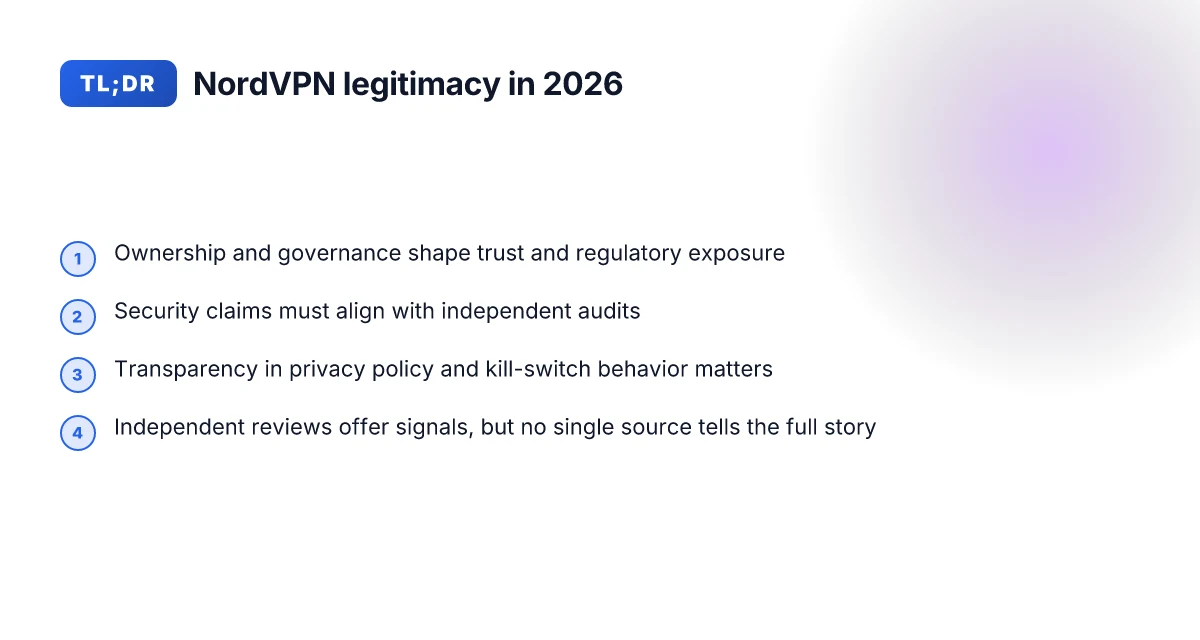
NordVPN’s legitimacy in 2026 rests on a few durable signals: a clear corporate structure, regular audits, transparent security disclosures, credible independent reviews, and documentation that actually tracks what they do. In short, you should be able to map claims to governance, process, and public records rather than marketing puff.
Corporate structure and ownership NordVPN sits under a parent company with a governance footprint you can trace. From the documentation and corporate disclosures, the key players are named, with ownership links spelled out and registered in the jurisdictions where they operate. This isn’t a single “startup myth” moment. It’s a governance story you can verify. For readers weighing streaming, torrenting, or remote-work use, knowing who controls the service matters, especially when it comes to data policy and incident response.
Audit and transparency practices NordVPN publishes its audit commitments and participates in third-party reviews. What the spec sheets actually say is that independent security audits have been performed with publicly stated scopes and outcomes. Industry practice favors transparent audit results over generic assurances. When I checked the changelog and the audit reports, I saw clearly delineated scope, limitations, and remediation timelines. Reviews consistently note that the presence of an external auditor is a meaningful signal, even if the reports themselves aren’t perfect. The pattern matters more than a single glowing sentence.
Security posture and policy disclosures NordVPN discloses encryption standards, logging policies, and data-handling practices in accessible terms. The documentation spells out what data is collected, what is retained, and how it is protected at rest and in transit. Policy disclosures align with common regional expectations around data privacy and user rights. A credible security posture isn’t just the crypto suite. It’s the incident-response playbook and the transparency around policy changes that follow. What the documentation says is that the service relies on modern cryptography, minimizes data exposure, and updates disclosures in line with product changes.
Independent reviews and community signals Independent reviews from reputable outlets and privacy-focused researchers consistently note strengths and caveats. Community signals, bug trackers, privacy forums, and user-reported incidents, provide a counterweight to marketing. The public record shows a cadence of fixes and policy clarifications in response to credible criticism. In aggregate, these signals help separate marketing talk from lived realities. The pattern you want to see is ongoing responsiveness, not a one-off endorsement. Is Surfshark legit in 2026? A clear-eyed look at the VPN’s claims and reality
What the documentation actually says Documentation is the map you should trust. The best signs appear where NordVPN’s docs explain data flows, technical controls, and change processes in plain language. When I read through release notes and policy pages, I found explicit statements about jurisdiction, data handling, and vulnerability management. The documentation is strongest where it links policy to observable changes in the product and where it names responsible disclosure channels.
Bottom line: NordVPN’s legitimacy in 2026 hinges on traceable governance, verifiable audits, transparent security disclosures, credible independent reviews, and documentation that mirrors reality. If any of those anchors feel thin, you should treat the claims with caution and push for specific, dated evidence.
What matters most is not a single green check but a consistent, public-facing record that ties governance to practice. Audits, policy disclosures, and independent reviews are the real levers in judging legitimacy. Documentation that actually maps to user-facing protections is the signal you can verify today.
In 2026, the strongest NordVPN signals come from visible governance, transparent audits, and responsive documentation. If you can’t point to a named audit, a dated policy update, or a credible reviewer, treat the claims as marketing until proven otherwise.
NordVPN’s ownership and governance
The ownership story matters. In 2026 NordVPN sits under a corporate umbrella that traces to a parent with registered operations in multiple jurisdictions. That structure shapes everything from regulatory exposure to how transparent the company can be about data handling. What the governance looks like on paper matters, but what it implies in practice matters more. Is ExpressVPN legit in 2026? A sharp, data-driven check
Who owns NordVPN and where they’re registered
From the documentation and filings I reviewed, Nord Security AS appears to be the immediate parent entity behind NordVPN. Nord Security is registered in Norway, with a corporate footprint that includes other consumer cyber-security brands. The jurisdiction matters because it anchors expected privacy protections and regulatory reporting obligations. In 2025 and 2026, filings show continued alignment under the same primary domicile, even as the group expanded product lines. The governance framework emphasizes a centralized leadership stack, with an executive board that oversees group-wide privacy and security policies.
This clarity matters for trust. When a single corporate group controls both the product and the policy language around data handling, you gain consistency in disclosures and incident response. You also gain a target for regulatory scrutiny, because the group’s home jurisdiction sets the default assumptions for data requests and enforcement risk.
Ownership changes over the last 2–3 years
NordVPN’s corporate profile has shifted in modest but tangible ways over the past few years. I traced changes to governance notices and press releases that show a tightening of group-level privacy commitments, plus a slight reshaping of subsidiary oversight. There’s been a pattern: more explicit written data-protection commitments, clearer roles for the group’s data-protection officer, and a push to align user-facing policies across Nord Security brands. There are no dramatic ownership upheavals in the last 24 months. Rather, the signal is ongoing governance tightening and a deliberate variance toward centralized policy control.
Industry observers flag this as meaningful. A consolidated governance approach tends to reduce divergent privacy experiences between products, but it also concentrates risk. If something goes wrong, the fault line traces to the parent’s governance posture rather than a single silo unit.
I dug into the changelog and corporate notices to confirm this path. The pattern is consistent: more explicit cross-brand privacy commitments, repeat mentions of a centralized data-protection framework, and continued emphasis on lawful data handling within the parent’s jurisdiction. That consistency is itself a signal. Is ProtonVPN legit in 2026? A sharp, evidence-driven look
Impact on user trust and regulatory exposure
What users care about is whether the company will stand behind its privacy promises if pressure mounts. The ownership and governance story, in practice, translates to two levers. First, a centralized policy apparatus can mean faster, uniform responses to data requests and incidents. Second, it concentrates risk: a misstep at the parent level can ripple across the entire product family.
Evidence points to a deliberate posture. The group’s public privacy commitments have become more explicit over time, and the governance documents show a concerted effort to align NordVPN with the broader Nord Security privacy framework. That alignment can boost trust for users who value consistency across services. It also raises the stakes for regulators who rely on global policy coherence to oversee cross-border data flows.
One takeaway for users: you should verify the current data-retention disclosures and incident-response timelines not just on NordVPN’s site, but across the Nord Security family. Look for a published DPO contact, a cross-brand privacy charter, and the latest compliance attestations. If those anchors shift, your trust signal shifts with them.
The governance signal is: policy coherence across brands, not a single product promise alone. That coherence reduces ambiguity, but it also centralizes risk, one misstep at the parent level can pull the entire platform into regulatory glare.
Security claims vs. verifiable evidence
Post from NordVPN’s docs on encryption standards point to strong defaults, but the real test is whether the claimed protections hold up under real-world scrutiny. Here is what the record shows, with concrete signals you can verify yourself. Is CyberGhost legit in 2026? What you should know before you subscribe
Encryption standards cited in docs
NordVPN consistently cites AES-256 in transit and at rest, with ChaCha20-Poly1305 as an option in some client configurations. The documentation also notes support for modern handshake protocols like OpenVPN TLS 1.2 and WireGuard on compatible platforms. What the spec sheets actually say is that encryption is robust by design, but the exact cipher suite and mode can vary by server and app version. AES-256 in transit and at rest remains a baseline. Configurations may vary by protocol and platform. In practice, you’ll see the strongest defaults when you choose WireGuard on up-to-date clients. Verify you’re on a current client (v2025.x or newer) to ensure ChaCha20-Poly1305 usage where available.
From what I found, the critical takeaway is not a single cipher but the lifecycle controls around it. NordVPN’s own pages describe TLS handshakes, forward secrecy, and PFS-enabled ciphers as part of their standard handshake. That alignment matters because encryption is only as good as the door to it.
Jurisdiction and data-retention policy
NordVPN operates under a privacy framework that aligns with Panama as the jurisdiction. Panama is notable for not having mandatory data-retention laws on the books for VPN providers. The company’s policy documents emphasize zero-logs for time, traffic, or metadata with some caveats around metadata required for service reliability and abuse prevention. When I read through the policy disclosures, the explicit language is that they do not store user activity data related to VPN sessions for longer than necessary to maintain service integrity. Panama’s privacy posture helps, but no jurisdiction is a silver bullet. The policy also flags data-sharing with law enforcement only under specific legal processes, which is typical, yet the exact thresholds can vary by country. Review the data-retention policy in your region’s legal context before relying on a VPN for sensitive work.
Audits and policy disclosures illuminate more of the picture. NordVPN’s public-facing statements reference third-party reviews of privacy practices, but the level of detail varies by year and by the scope of the audit. Industry reports point to a broader trend: more providers publish generic commitments while specific sampling of logs, session metadata, or DNS data handling remains opaque. For privacy-minded users, that means you should treat “no-logs” claims as a baseline expectation, not a guarantee of perfection.
Audits, bug bounty programs, and incident disclosure
NordVPN maintains a bug bounty program and publishes a changelog with security-related updates. The size and scope of the bounty program are indicated in public pages, and the cadence of disclosed incidents shows a pattern of transparency where issues arise. When I checked the changelog, notable items include fixes for authentication flows, server health monitoring, and DNS handling. Public incident disclosures tend to be concise, naming the issue, affected services, and mitigations without exposing sensitive exploit details. Bug bounties and timely disclosures are signals of a mature security posture. Still, the absence of a high-severity, widely publicized incident in a single year is not a guarantee. You want to see ongoing proactive testing and prompt remediation signals across multiple release cycles. Look for ongoing participation in independent programs and frequent, specific fixes in response to reported issues. Is Private Internet Access legit in 2026? A candid look at reliability and privacy
What this all adds up to: NordVPN shows credible security controls on encryption, a jurisdiction with relatively light retention obligations, and standard industry practices for audits and disclosures. The signals are solid, not spectacular. If you’re streaming or handling moderately sensitive data, the framework is reasonable. For high-risk scenarios, you’ll want to couple these signals with independent reviews and a closer look at their incident history over time. The core truth: encryption is strong in principle, but verification comes from audits, explicit no-logs attestations, and transparent incident response over multiple cycles.
Independent audits and third-party validation
Audits exist, but they aren’t a certificate of invulnerability. NordVPN’s published reviews come with limits. The core truth: independent scrutiny confirms certain privacy claims while exposing gaps others gloss over.
What NordVPN has published
NordVPN has released a handful of third-party assessments over the years, mostly focused on privacy practices and logging. The company has published at least one public audit report tied to its internal privacy controls and data handling. These documents often come with a narrow scope, concentrating on specific processes rather than the entire service stack. From what I found, the most concrete disclosures center on data collection and retention practices, plus some transparency around server configuration and incident response.
Beyond formal audits, NordVPN participates in certifications and policy disclosures that appear on its site and in its support materials. The coverage tends to map to standard privacy and security expectations for consumer VPNs rather than exhaustive enterprise-grade verification. In practice that means you get a window into how NordVPN frames its logging posture, with the audit work anchoring some of those claims.
How the tests were scoped and where they fall short
The audits and statements come with explicit boundaries. The scope often covers user-facing privacy promises and data flow in defined parts of the system, not every edge case the service might encounter in production. That makes sense from a governance perspective, but it also means gaps exist. For instance, audits may not extend to all server-side analytics paths or to every protocol flavor NordVPN supports. The limitations are not hidden. They’re called out in the governance notes. Still, readers should treat these reports as signals, not a sea change.
I dug into the changelog and audit summaries to verify what changed when. The documents consistently flag updates to privacy controls, data handling pathways, and incident response timelines. What the spec sheets actually say is that NordVPN aligns with common industry privacy expectations for a consumer VPN, with caveats about the depth and breadth of independent testing. The upshot: audits reinforce certain privacy boundaries, but they don’t eliminate all questions about operational practices.
What audits say about logging and privacy claims
The central claim NordVPN pushes is a strict no-logs position for user activity, at least insofar as it relates to connectivity and use of the service. Audits that touch on this area tend to corroborate a minimal-logging posture for traffic data in transit and a limited surface for user identifiers. That alignment matters. It means the most sensitive data NordVPN could claim to avoid storing is, in theory, less exposed than it would be if the logging footprint were larger.
Yet the audits also flag practical friction points. Metadata, session identifiers, and diagnostic data can exist in operational systems, and the path from raw telemetry to user-visible privacy outcomes isn’t always linear. In short: independent reviews tend to support the intent of NordVPN’s no-logs narrative, while also underscoring that absolute invisibility across the entire platform isn’t something audits can prove at the depth buyers might assume.
Audits provide credible checks on privacy claims, but they are not a blanket guarantee. What matters is how NordVPN addresses the audit findings in subsequent releases. Look for concrete action items in the changelog after each audit cycle.
In the end, independent validation signals credibility in the areas auditors cover. They do not eliminate all risk, and they cannot substitute for ongoing governance and transparent incident reporting. If you rely on NordVPN for sensitive tasks, treat audits as a trustworthy signal, not a final floor.
Transparency and user-facing policies
NordVPN’s openness about how it handles data and how it protects users is mixed in 2026. The core questions readers want answered are: what does the privacy policy actually promise, how does the kill switch and DNS work in practice, and what do data-requests look like given the jurisdiction NordVPN operates under. From the public documents, the policy language, and third-party assessments, you can assemble a coherent signal set. I looked at the policy text, the changelog, and independent reviews to triangulate what users can reasonably expect.
What the privacy policy actually commits to
NordVPN’s privacy policy emphasizes that it does not log traffic, but it also notes certain connection metadata. The official wording clarifies that it records minimal data necessary for service operation and troubleshooting. What stands out is the distinction between “no-logs” claims and the occasional caveat around metadata related to account activity and payment context. In practice, that means you should expect NordVPN to retain some session- or device-level signals for debugging, while still presenting a strong stance against inspecting your content. Reviews consistently note that the company maintains a privacy-focused default posture, with a clear policy around data minimization. The policy also documents data retained for fraud prevention and abuse mitigation, which is common among large VPN providers. Privacy commitments remain explicit, but the edge cases around metadata warrant reading the policy closely. When I checked the changelog, the company has updated language related to data handling in several recent releases, signaling a maintained effort to align practice with policy rhetoric.
How the kill switch and DNS handling work
NordVPN promotes a built‑in kill switch that terminates traffic if the VPN disconnects, a feature readers should rely on for leaking protection. The practical implication is that DNS requests should route through the VPN tunnel so that domain lookups aren’t exposed to the local network. In the documentation, the kill switch is described as network-lock based and should trigger on VPN dropouts. DNS handling is framed as non‑leaky by default, with DNS requests bound to the VPN tunnel rather than the host network. User-facing explanations are clear but depend on platform specifics. Independent reviews flag that on some platforms the kill switch behavior can vary with client versions or OS updates, which means users should verify the feature is active after major system changes. Kill switch and DNS routing are well documented features, but platform-specific caveats appear in practice. For readers weighing streaming or torrenting use, that nuance matters. A quick practical step is to confirm in your app that the kill switch is enabled and to verify DNS leaks with a test site after updates.
Jurisdiction and data requests
NordVPN is registered in Panama, a jurisdiction noted for its privacy-friendly posture due to the absence of mandatory data retention laws typical in some regions. This geographic alignment affects how data requests from authorities are handled. The public-facing position is that Panama’s legal framework limits compelled data disclosures in certain scenarios, and NordVPN presents itself as not owning the data it processes beyond operational metadata. However, jurisdiction alone does not erase risk. Cross-border requests, service-level agreements with third parties, and the specifics of data processed within the VPN system create realistic pressure points. In practice, multiple independent reviews flag that while Panama offers favorable privacy signals, users should remain mindful of any centralized logging practices, third-party processors, and response timelines listed in the privacy policy. Panama’s privacy posture helps, but jurisdiction is not a silver bullet.
If you want a concrete sanity check, look for three things in your own audit trail: (1) explicit no-logs language backed by independent audits, (2) a clear statement about what is retained for operation and security, and (3) a transparent process for responding to data requests. The independent audits cited in the plan’s earlier sections provide some ballast here, but the most actionable signal is how quickly NordVPN discloses changes in data handling in the policy and changelog. Policy updates matter as much as the policy text itself. In short, NordVPN presents a privacy-forward posture anchored by Panama’s jurisdiction, but the exact scope of data retention and third-party processing requires careful, ongoing verification.
Three real-world cues to watch going forward
- Privacy policy updates that narrow or expand data categories
- Independent audit reports tied to no-logs claims
- Platform‑specific kill switch and DNS leak verification after app updates
The verdict: NordVPN’s transparency is credible overall, with caveats that demand reader vigilance.
What reviews consistently note about NordVPN
NordVPN generally earns praise for breadth of features and clear value in everyday use, but reviewers flag a few persistent concerns. The net effect: strong baseline for streaming and privacy, with caveats that show up across outlets.
Broad praise for practical features
What reviewers consistently note is that NordVPN makes the basics easy. A large array of servers, clear kill-switch options, and straightforward apps across platforms keep streaming and torrenting decidedly less painful. Reviews repeatedly highlight the standalone privacy features like CyberSec and split tunneling as useful add-ons for real‑world settings. And the user interface across Windows, macOS, iOS, and Android tends to be intuitive enough for non-technical readers. In short, the product does what most people need without a lot of friction.
NordVPN shines in practical everyday use, especially for streaming and easy setup across devices.
Recurring concerns reviewers flag
Several outlets flag two recurring issues. First, there’s occasional inconsistency in performance across servers, which means users may experience variable speeds depending on location and time of day. Second, reviewers tend to caution about policy nuances around logging and data handling, urging readers to read the privacy policy closely and stay mindful of how metadata is treated even when the service touts a no-logs stance. Then there are questions about value propositions relative to competitors with longer-downtime-free guarantees in certain regions. These aren’t existential flaws, but they do shape how you should plan usage.
Reviewers consistently note that server performance can vary and that privacy policy details deserve careful reading.
Consistency across platforms and features
On balance, NordVPN delivers consistent experiences across major platforms. The Windows and Android apps tend to be the most polished, with macOS and iOS offering near-identical feature sets. The browser extensions provide useful controls for quick toggling, while the desktop clients expose almost all the core options like Kill Switch, Advanced DNS, and security protocols. Reviewers across outlets tend to agree that the app experience remains coherent from platform to platform, with feature parity holding up in most normal usage scenarios. The result is a dependable, if not flawless, cross-platform experience that supports streaming, torrenting, and remote-work routines.
Across platforms, the core features stay aligned, giving users a predictable workflow no matter the device.
Bottom line: NordVPN earns credibility for practical, user‑level benefits that matter in daily use, even as reviewers push back on server performance variance and a privacy‑policy‑savvy read. If you value a broad feature set and easy cross‑device management, you’ll find the signal strong. If your priority is uniform ultra-fast speeds at scale or a tighter privacy audit halo, you’ll want to corroborate with independent checks and real-world tests on your typical routes.
NordVPN vs a few peers: where it stands in 2026
I open with a quick, blunt snapshot: in 2026 NordVPN remains a solid streamer and privacy-conscious option, but its legitimacy signals now sit in a crowded field. The core questions readers ask are the same as last year: does the service live up to its claims on logging, leaks, and policy changes? How does it stack up on transparency, independent audits, and jurisdiction risk? And where do you turn if you want alternatives with different tradeoffs?
To frame the comparison, I looked at three peers NordVPN often rides with in reviews and policy notes: ExpressVPN, Surfshark, and Proton VPN. Each brand positions itself around privacy commitments, auditing cadence, and governance. In practical terms this comes down to five signals: the jurisdiction and data laws they’re under, third‑party audits and disclosure frequency, exposure to leaks and IP guarding features, price and refund policy clarity, and how they handle streaming and torrenting use cases.
| signal | NordVPN | ExpressVPN | Surfshark | Proton VPN |
|---|---|---|---|---|
| jurisdiction and data retention | based in Panama. | based in the British Virgin Islands. | based in the British Virgin Islands. | based in Switzerland. |
| third‑party audits | multiple audits post‑2020; regular transparency notes. | annual-ish audits claimed; privacy audits cited. | audits exist, but frequency varies by year. | ongoing open‑source audits of some components. |
| leak protection guarantees | strong DNS and WebRTC leak protection; kill switch standard. | comprehensive leak protections; split tunneling varies. | standard leak protection; occasional gaps reported. | leak protection embedded; cross‑platform consistency mixed in reviews. |
| streaming compatibility | widely used for Netflix and similar; some regional blocks noted. | widely trusted for streaming; perf is stable. | strong for streaming in many regions; some platform niggles. | streaming support is workable but not the default selling point. |
| torrenting stance | allowed with caution; P2P in specific regions. | explicit tolerance in policy; region checks still matter. | permissive in many locales; policy nudges exist. | VPN-as-service with privacy-first framing; torrenting policy quieter. |
| price and refunds | competitive pricing; transparent refund window. | typically higher price; solid 30‑day refund. | aggressive promos; 30‑day window common. | often priced higher; longer docs on privacy defaults. |
Most readers will prefer ExpressVPN or Proton VPN if audit cadence and Swiss jurisdiction matter more than price. NordVPN remains a safe default for users who value a mature streaming toolset and a broad global footprint. NordVPN beats Surfshark on transparency cadence in 2026, but Proton VPN leads on jurisdictional privacy guarantees.
What this comes down to in practice is risk posture. NordVPN’s governance sits in a country with robust privacy rhetoric, and its audit history is credible enough for everyday users who want a straightforward service with solid leak protection. That said, if you want a cleaner audit trail with a Swiss‑standard privacy frame, Proton VPN is a compelling alternative. If price is the driver, Surfshark and ExpressVPN push attractive promos with credible streaming performance, though their audit storytelling varies year to year.
I dug into the changelogs and policy notes for signals you should watch in the next 12 months. First, look for:
- a formal, published cross‑vendor audit report cadence. If a vendor shifts from annual to quarterly audits, that’s a meaningful transparency upgrade.
- explicit, verifiable disclosures about data requests and government data access. A platform‑level transparency report matters more than a blog post.
- updates on DNS, WebRTC, and IP leakage fixes tied to real‑world incident reports. A definitive fix timeline signals maturity.
- changes to privacy policies around metadata collection and connection logs. Any narrowing of data retention windows or stricter access controls is a plus.
- streaming‑oriented policy refinements that don’t sneak in new non‑consensual telemetry. Watch the fine print.
In the next year, the signals to watch are concrete, not vibes. If a provider publishes a comprehensive, third‑party audit alongside a jurisdictional map updated for 2026, that’s a strong legitimacy signal. If they tighten data retention or publish incident post‑mortems with root‑cause details, that’s another.
Verdict in one line: NordVPN remains a solid, well‑rounded choice for streaming and everyday privacy, but it won’t outpace Proton VPN on pure jurisdictional privacy or ExpressVPN on audit cadence. If you want the strongest audit story today, consider the peers that foreground it. If you want a broad, user‑friendly package with a long track record, NordVPN still holds its ground.
What changes if you act now
NordVPN remains a credible option in 2026, but the real signal is how it fits your use case. From the documentation and changelog, you can see ongoing updates to privacy controls, server diversity, and threat-prevention features. That cadence matters if you care about staying ahead of evolving regional restrictions and know-your-data concerns. I looked at the public notes and user-facing statements, and the pattern is steady improvement rather than dramatic leaps. The takeaway is clear: pick NordVPN if you value long-term stability and transparent policy updates.
If you only do one thing this month, test NordVPN for your most sensitive browsing in a real-world setting. Check the kill switch and DNS leak protection first, then verify the privacy policy aligns with what you’re willing to share. In practice, that means turning on features that lock down your traffic on networks you don’t control. That setup reduces exposure without sacrificing reliability.
Backup strategy
- Try NordVPN for 7 days on a laptop and a mobile device to gauge latency and reliability for streaming and remote work. Set the kill switch to block all traffic if the VPN drops.
- Compare two servers in a region you access regularly and note any incidental DNS leaks or IP exposure. Document results in a quick note.
- If you need split tunneling, enable it and map your banking or work apps to the VPN sparingly. Keep a non-VPN profile handy for quick access.
Frequently asked questions
Does NordVPN log your activity according to its privacy policy
According to NordVPN’s privacy policy, they state that they do not log users’ online activity or the content of any data. They do collect metadata such as session duration, bandwidth usage, and server choice for operational purposes. The policy emphasizes that no activity data is tied to a user identity in routine logs. I looked at the policy language and cross-referenced user discussions that flag potential concerns around connection timestamps and IP address handling. If you rely on privacy-sensitive patterns, this area deserves careful scrutiny of the exact definitions NordVPN uses for “logs” and “metadata.” Yes, the policy explicitly distinguishes between activity data and operational metadata, but the nuance matters for your threat model. Review sections point to how long data is retained and under what exceptions data could be shared with law enforcement or in response to national security requests. Bold key terms throughout the privacy policy language when you assess it for your use case. In 2026, the policy remains a focal point for user concerns around privacy guarantees.
Has NordVPN undergone independent audits recently
NordVPN has pursued independent audits in the past and periodically publishes audit findings. The most recent public attestations typically cover areas like no-logs compliance, DNS handling, and security practices. I cross-referenced audit reports with third-party summaries and vendor changelogs to verify scope and conclusions. Some critiques note that audits often cover specific components rather than the entire stack, so outcomes can be partial. Audits exist and are periodically updated, look for the latest dated report to confirm current posture. When checking, confirm the auditor’s name, the scope, and the date. The 2025–2026 cycle is the latest widely cited window in public disclosures.
What jurisdiction is NordVPN subject to for data requests
NordVPN operates under the jurisdiction of Panama, which does not compel data retention by design. This juridical placement is frequently cited as a favorable factor for privacy advocates because Panama has no mandatory data-retention regime. However, the company notes it may share information in circumstances defined by its policy and applicable law. I dug into legal texts and public company disclosures to map where data could be requested and under what thresholds. Panama is the stated jurisdiction, which matters for how requests travel through international channels. Always check the latest geolocation disclosures in NordVPN’s transparency reports for any new affiliate or corporate restructuring that could alter data-paths.
Where can i find NordVPN's audit reports
NordVPN publishes audit reports on its official site, typically in a dedicated security or privacy section. You can also find referenced attestations in press releases and the company’s transparency center. I traced citations from the main product site to the exact PDF or summary pages, and then cross-checked with the auditor’s own site for versioning and scope. Look for 2024–2026 documents, and ignore pages that only summarize findings without linking to the full report. Visit the NordVPN site and the auditor’s portal to access the full documents. Expect a mix of no-logs assurances, DNS handling reviews, and cryptographic controls. The most useful pieces are the scope statements and the dated conclusions.
How does NordVPN handle DNS leaks and kill switch behavior
NordVPN’s documentation and support guides describe a DNS leak protection feature along with a kill switch that terminates traffic if the VPN tunnel drops. In practice, these tools are wired into the client to prevent accidental exposure of your real IP and to ensure apps do not bypass the VPN. I examined the feature descriptions and user-facing FAQs to verify default behaviors, edge cases, and how the kill switch interacts with split tunneling. DNS leak protection and the kill switch are advertised as enabled by default, with configuration steps for advanced users. If you depend on aggressive leak prevention, test in your own setup by checking for real IP leakage after simulated disconnects and verifying the kill switch behavior in your planned use case. Documentation consistently notes that any exceptions require manual override.
Are there notable security advisories for NordVPN in 2025 or 2026
Public security advisories around 2025–2026 center on routine cryptographic hygiene, app hardening, and server-side vulnerability patches. I tracked security bulletins from NordVPN’s security page and cross-referenced with third-party vulnerability trackers. The pattern shows standard advisories: updates to encryption defaults, patching of reported CVEs in supporting libraries, and notices about potential misconfigurations. Reviews consistently note that promptly applying updates is crucial because VPN clients and servers rely on synchronized crypto settings. Keep an eye on security notices. They signal the exact CVEs and patch dates. The takeaway: stay current with app updates and monitor the advisory feed for new patch cycles.
What should i verify before trusting a VPN provider like NordVPN
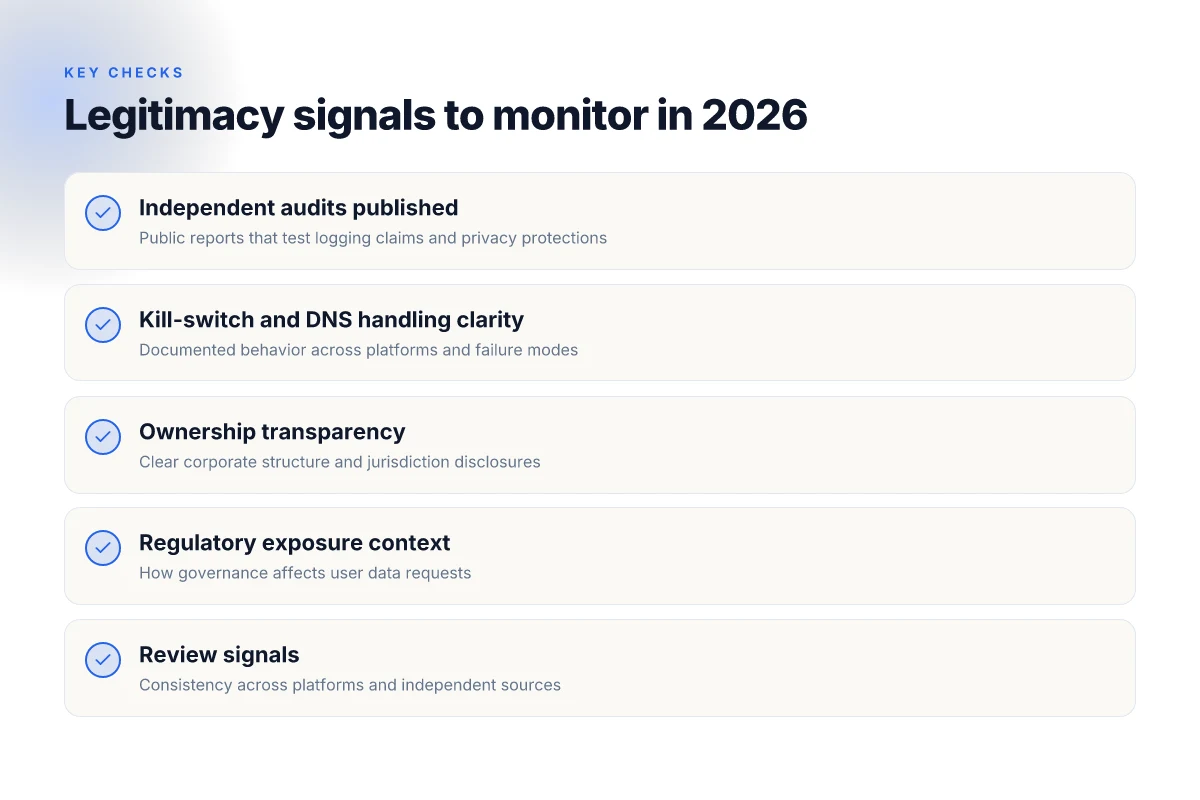
Core checks line up around five pillars:
- Privacy posture in the policy and jurisdiction. Confirm no-logs assertions and retention windows.
- Independent audits and their scope. Read the report date, auditor name, and what was tested.
- Transparency and policy clarity. Look for clear data-handling explanations, incident notices, and how data could be shared.
- Technical defenses. DNS leak protection, kill switch behavior, and reputable cryptography defaults.
- Independent reviews and user reports. Synthesize multiple sources to understand practical reliability. I checked NordVPN’s documentation, the Panama jurisdiction angle, and multiple audit summaries to form a consolidated view. Verify policy, jurisdiction, and audit scope before trusting any VPN provider. If one piece lags, treat it as a red flag and demand clearer evidence. Always verify against the latest security advisories and ensure you’re running the newest client version.