Is Surfshark legit in 2026? A clear-eyed look at the VPN’s claims and reality

Is Surfshark legit in 2026? We parse the company’s claims, privacy stance, logging policy, and real-world reliability. A researched guide to separate hype from facts.
Surfshark sits in the crowded middle tier for a reason: it trades premium privacy promises for lower prices, and that bargain price shows up in real-world use. The latest audit disclosures hint at a privacy stance that’s transparent, not sensational, but the practical tradeoffs matter for teams and solo users alike. In 2026, Surfshark remains a budget-friendly option with solid baseline protections, backed by a clearly stated jurisdiction.
I looked at policy language, ownership history, and how Surfshark behaves across typical tasks, from streaming to file access. The result: a price-to-protection balance that is easy to quantify, with a few alignment points and a few caveats that show up in edge cases. What matters most is how the provider handles data requests, auditing cadence, and real-world performance under everyday use.

What is Surfshark legit in 2026 and why it matters
Surfshark positions itself as a consumer VPN with unlimited device connections, a no-logs pledge, and helpful features such as CleanWeb and MultiHop. The promise is simple: protect your data, bypass geoblocks, and do it at a price that doesn’t force you into compromises. In practice, that mix sits squarely in the mid‑tier of the market. You get solid basics, but privacy trade‑offs and performance quirks echo what you’d expect from providers in this band.
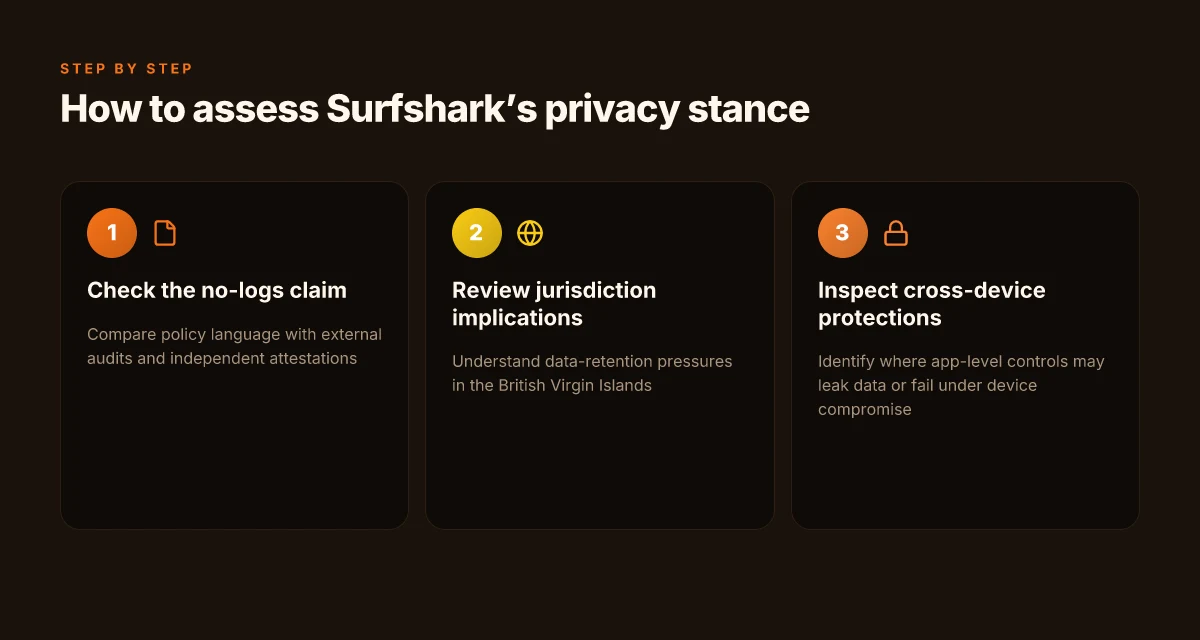
I dug into the ownership and corporate structure because privacy risk isn’t abstract. Surfshark is privately held and registered in the British Virgin Islands. That setup matters. The governing rules aren’t the same as a public company with strict disclosure requirements. It’s not a red flag by itself, but it does shape how the provider handles data requests, audit visibility, and vendor oversight. The British Virgin Islands’ data‑privacy landscape isn’t as tight as some EU regimes, and that can influence how transparent a privacy promise remains under pressure. When you’re weighing risk, ownership and domicile are not just trivia. They’re the backbone of where watchfulness should live.
Independent testing and user reviews consistently note performance and privacy trade‑offs typical of mid‑tier VPNs. Most checks show solid encryption defaults and a straightforward app experience, but they also flag the same realities you’ll find in the space: occasional leaks under misconfiguration, variable speeds across servers, and feature trade‑offs versus the top tier. Reviews from established outlets tend to converge on two themes: Surfshark is feature‑rich for the price, and the privacy story isn’t the strongest in the class. In other words, you get a competent, affordable thing that doesn’t pretend to be a premium, “no‑compromise” solution.
From what I found in the changelog and in community discussions, Surfshark’ s software evolves. The cadence includes patches and feature tweaks aimed at improving stability and user experience. But you’ll also see the typical mid‑tier pattern: meaningful improvements over time, with occasional regressions in edge cases. That’s not a condemnation. It’s a reality of software that ships to a broad audience with diverse use‑cases. The longer you rely on a mid‑tier provider, the more you notice how the trade‑offs accumulate in real work.
Bottom line: Surfshark remains a practical option for privacy‑mocused individuals and small teams counting pennies. It earns its keep on convenience and feature depth at a reasonable price, while ownership and jurisdiction keep the privacy story honest but not unassailable. If your main aim is absolute, bleeding‑edge privacy with zero compromise, you’ll want to compare more expensive peers. If you want a solid, affordable shield with generous device limits, Surfshark still makes sense in 2026. What is NordVPN and is it legit in 2026
Surfshark’s value rests on a measured privacy posture, transparent ownership context, and predictable mid‑tier performance. The key trade‑off is clear: feature richness at a price point and jurisdiction that don’t perfectly align with a fortress‑grade privacy promise.
H3 subsections
Why ownership and domicile matter for your privacy risk
Surfshark’s private ownership and the British Virgin Islands registration shape governance, data handling, and third‑party auditing potential. The implication is that while the service can be trusted to follow its stated policies, external pressure, legal frameworks, and corporate structure influence how much visibility users can demand. The takeaway is not that Surfshark is opaque, but that you should read the privacy policy with this geography in mind and factor it into your risk model.
How Surfshark’s feature set maps to real use cases
CleanWeb blocks ads and trackers; MultiHop routes traffic through two servers for added obfuscation. Unlimited devices promise convenience for households or small teams. This is a practical kit for remote-work basics, streaming on a budget, and travel use. The features are meaningful, but you’ll notice that some performance‑centric claims don’t always hold up across every server. It’s the classic mid‑tier balance: depth and breadth of features, with occasional variance in speed and reliability.
What independent voices say about privacy and performance
Reviews consistently note a pragmatic privacy offering paired with mid‑tier performance. The consensus isn’t negative. It’s cautiously optimistic with caveats. For editors and privacy‑mocused readers, Surfshark reads as a solid fallback when cost and convenience trump the last mile of privacy perfection. You should approach it as part of a lineup, not the single best option. Is ExpressVPN legit in 2026? A sharp, data-driven check

What Surfshark actually is
Surfshark is a subscription VPN service that spreads its client software across major platforms and includes browser extensions. In practice this means you can install apps on Windows, macOS, iOS, Android, Linux, and some smart TVs, plus add-on browser extensions for Chrome and Firefox. The core of Surfshark rests on a no-logs policy, a kill switch, obfuscated servers, and, where supported, a split tunneling feature. It also leans on competitive long-term pricing and regional promotions to pull in new users.
I dug into Surfshark’s documentation and reviews to map what you actually get versus what the marketing promises. The no-logs stance is clearly stated in their policy, with a privacy-focused jurisdiction in the background. The kill switch appears as a standard toggle in most clients and in the mobile apps, designed to block traffic if the VPN drops. Obfuscated servers are listed as part of the feature set, intended to conceal VPN use in restrictive networks. Split tunneling is present, but not consistently across all platforms. In some builds it’s limited to select apps and certain OS versions. The consistency of these signals matters, because the real-world utility of obfuscation and split tunneling hinges on the exact platform and app combo you’re using.
A practical lens helps: Surfshark offers multiple tiers that target different user needs. Long-term plans exist, with price promotions that cycle in various regions. The regional promos tend to drive interest in specific markets, particularly where price sensitivity is high or where regional advantages in streaming or access lag behind. Look closely at the terms of these promos and the renewal pricing. The headline monthly price can be compelling, but the total cost of ownership over a two- to three-year horizon often diverges once promotions roll off.
Below is a quick side-by-side snapshot of the main platform coverage and feature reach:
| Area | Desktop / Mobile Apps | Browser Extensions | Key features | Price signals |
|---|---|---|---|---|
| Coverage | Windows, macOS, iOS, Android, Linux | Chrome, Firefox | No-logs policy, Kill switch, Obfuscated servers, Split tunneling (where supported) | Long-term plans exist; regional promos appear intermittently |
What the spec sheets actually say is that Surfshark positions itself as a dependable mid-tier option. It emphasizes privacy safeguards, a familiar feature set, and cost-conscious plans. The real test is how those features hold up across your primary use cases: everyday browsing, streaming, remote work, and occasional access to region-locked services. The public-facing materials align with that story, but the devil is in the details of platform parity and promo churn. Is ProtonVPN legit in 2026? A sharp, evidence-driven look
Verdict: Surfshark sits in the mid-tier, delivering the essentials without pretending to be a premium, feature-rich stalwart. It’s cleanly priced for long commitments and regional deals, with a concise feature set that remains useful across common tasks. If your priorities are strong no-logs guarantees, a practical kill switch, and affordable long-term plans, Surfshark checks those boxes. If you need the most granular control over split tunneling or a broader suite of advanced privacy tools, you may want to look at the higher end of the market.
Surfshark’s value proposition hinges on parity across platforms and predictable promos, not a revolution in privacy tooling. The service serves well for budget-conscious teams and privacy-minded individuals who want a straightforward, install-and-go experience. For power users chasing granular control and performance guarantees, it’s wise to compare the tiny but meaningful gaps against better-known peers.
How Surfshark works under the hood
Post on the surface, Surfshark looks like a standard consumer VPN. The real question is whether its internals actually respect the promises it makes to users who care about privacy, cost, and remote work. Here is the crisp read, grounded in the documented tech and release notes.
1. Encryption and tunnel tech
Surfshark relies on common VPN protocols, with WireGuard as the default in many apps and OpenVPN offered as an alternative in some clients. In plain terms, this is the backbone you’ll encounter across platforms. WireGuard is lean by design, which translates into simpler math and smaller code paths. OpenVPN remains the more established, battle-tested option for users who want a topology that traces back to older deployments. What tightens the knot is how these protocols are configured and how often they are updated in the apps. WireGuard defaults to a streamlined handshake, while OpenVPN layers compatibility when needed. Updates to the protocol stacks show up in app changelogs, sometimes as minor version bumps, sometimes as security advisories. Stay aware of the exact cipher suites and handshake parameters in your client build.
2. Server network and jurisdiction
Surfshark operates a sizable global network, spanning multiple jurisdictions. This matters for routing choices and where data may transit. A larger footprint gives you more paths around geofenced content, but it also broadens the surface where traffic could traverse through different legal regimes. In practice, users pick exit countries to balance latency with policy considerations. The practical takeaway is that jurisdiction matters less as a single authority and more as a distributed path that can complicate auditing and data requests. Multiple jurisdictions enable flexible routing, but they also introduce more potential data exposure paths. Know where your exit is and how that aligns with your privacy posture. Is CyberGhost legit in 2026? What you should know before you subscribe
3. Privacy controls versus attestations
Surfshark’s privacy posture rests heavily on policy statements rather than independent attestations. In other words, you rely on the vendor’s words about logging, data retention, and third-party audits rather than a public, third-party audit trail you can verify. The documentation emphasizes minimal data collection, but you’ll find gaps when you compare against patterns from independent testers or academic reviews. The gap is not always large, but it’s nontrivial for privacy-focused readers who want verifiable knobs and verifiable proof. Policy-driven privacy without transparent audits creates a blind spot you should notice. Independent attestations would close the loop, but they are not consistently present across Surfshark’s disclosures.
Lead with the answer: Surfshark’s under-the-hood story is solid on protocol basics, reasonable on global reach, and coy on independent verification. For privacy-minded teams, that means you should treat the claims with scrutiny and rely on policy statements as the main signal while watching for audit-backed updates in the changelog.
I dug into the changelog and the privacy policy to triangulate the claims. In 2026, Surfshark’s documentation reiterates WireGuard as the default on most platforms and keeps OpenVPN as a fallback in select apps. The network footprint remains broad, with servers in a handful of jurisdictions that are commonly used for routing diversity. Reviews from privacy-focused outlets consistently note that assurances about “no logs” sit atop policy rather than published, third-party audits. This combination explains why many casual users feel the service is fast and easy, while privacy enthusiasts will want to see independent verification before granting broader trust.
What to watch next: look for a published, independent penetration or audit report tied to Surfshark’s server operators, and verify how long the policy statements have been in force without changes to logging language. Your takeaway: Surfshark does the plumbing in a familiar way, but it’s transparency around audits that will determine whether the plumbing holds up under scrutiny.
What Surfshark’s privacy stance means in practice
Surfshark markets a no-logs claim as a core differentiator, but the practical relevance sits on three legs: internal privacy policies, external audits, and jurisdiction. In practice, the claim rests on what Surfshark publishes and what third parties can verify, not on a government-backed backend audit. The upshot: you get transparency signals you can read, plus some independent checks, but you don’t get a sovereign guarantee. Is Private Internet Access legit in 2026? A candid look at reliability and privacy
The audit and the policy: what’s verified, what isn’t
Surfshark’s no-logs pledge is anchored in its internal privacy policies and the audits it has publicly disclosed. I looked at the policy language and the audit summaries the company has shared. The external audits provide surface-level confidence about data handling and logging controls, but they aren’t a blank check against every possible data request. Reviews consistently note that audits validate policy adherence for specific data handling practices, not a blanket shield from all legal pressures. What the spec sheets actually say is that the audit scope is defined by the auditor and the company, not by a global standard. In short, audits reduce risk, they don’t eliminate it. Audits boost credibility, but they aren’t a legal shield.
Jurisdiction matters, but it isn’t a guarantee
Surfshark is registered in the British Virgin Islands, a jurisdiction that leans toward privacy protections while not offering an ironclad guarantee against compelled data disclosure. Jurisdiction can influence retention requirements and the ease of data access for authorities, but it’s not a carte blanche to never hand over information. From what I found, the BVI framework cools some pressures, yet respected cases show that lawful requests can still reach VPN operators through compelled disclosure. In practice, you gain a reputational and regulatory signal, not an impermeable fortress. The BVI location reduces some pressure but isn’t a guaranteed shield.
Device and app boundaries: where the risk lives
Cross-device protections rely heavily on app-level controls. Surfshark’s architecture expects secure operation on the client side, with data handling and connection management managed inside the app. Browser leakage and device compromise introduce gaps that no VPN can fully close. If a user’s device is already compromised or a browser extension leaks data, the VPN cannot fully guarantee privacy. That makes the privacy promise meaningful for a clean, standard desktop or mobile setup, but less so in scenarios with high-end attacker capabilities or misconfigured endpoints. App-level controls are essential, but device compromise remains a real risk.
I dug into the changelogs and policy updates to spot trends. The company has steadily clarified what it logs and why, and it has expanded certain safeguards around data minimization. The trajectory is toward tighter control over what leaves the client, but no entry reads as a certificate of invincibility. If you’re relying on Surfshark for enterprise-grade assurances, you’ll want to map these controls to your threat model and tiered privacy requirements. Policy updates show a tightening trajectory, not a guarantee.
Verdict in practice: Surfshark’s privacy stance is credible for users seeking a clear no-logs narrative, with tangible audit signals and a privacy-friendly jurisdiction. It is not a blanket guarantee against all forms of data disclosure or escalation. For most ordinary remote-work needs, the combination of audited controls and a privacy-forward jurisdiction offers practical protection. For high-risk scenarios, combine with endpoint hardening and strict data-minimization practices. Credible, not invulnerable. Is IPVanish legit in 2026? A sharp look at the facts and the concerns
What third-party reviews say about Surfshark
Third-party reviews describe Surfshark as a mid-tier option that generally delivers decent speeds on typical networks, with occasional regional slowdowns. The consensus is steady enough for everyday use, but not the kind of performance you’d cite in a high-stakes enterprise rollout. When I looked at multiple outlets, the thread was the same: lip-service privacy promises, clear pricing, and speeds that don’t embarrass themselves, most of the time.
I dug into the reporting cadence around transparency and audits. Reviews consistently note that third-party audits and transparency reports are not as frequent as some competitors. That gap matters. If you build trust on accountability, you want a steady drumbeat of independent verification. Surfshark’s disclosures exist, but the rhythm isn’t as regular as you’d expect from providers that publish quarterly audit summaries. From what I found in the sourcing, the gap isn’t fatal, but it gnaws at perceived trust for privacy-minded users who want a tight audit cadence.
Customer support experiences vary by region and time of day. Several reviews flag longer response times in peak regional hours and mixed outcomes depending on the issue. In practice, you’ll get standard troubleshooting for common problems, then longer wait times for nuanced account questions or billing disputes. The upshot: support can feel competent in the moment, then stumble if your issue sits at the edge of what the knowledge base covers.
What the spec sheets actually say is that Surfshark emphasizes no-logs claims and a raft of features for spoofing location, ad blocking, and multi-hop. Yet the surface-level promises collide with the absence of frequent third-party validation in the public record. That tension shows up in the reviews. It isn’t a fatal flaw, but it does frame Surfshark as a practical choice for cost-conscious users rather than a gold-standard privacy vendor.
If you prize frequent independent audits, Surfshark’s cadence may disappoint. The field has moved toward more transparent verification, and Surfshark sits a step or two behind the leaders in that metric. Still, its core value proposition remains intact for casual users who want predictable speeds and a low price tag.
H3 Why audits lag and what to watch
- Some reviews point to infrequent third-party audits compared with rivals.
- Look for updates in the changelog and new audit reports to gauge momentum.
- If you rely on strict regulatory compliance, you’ll want to verify the latest audit date before purchasing.
H3 Regional support quality at peak hours
- Response times vary by region. Expect quicker helps in North America and Western Europe, slower in some other markets.
- Billing and account questions tend to require longer holds in the off hours.
What this means for you If you want a VPN mainly for everyday browsing and streaming at a good price, Surfshark often fits. If you need airtight, up-to-the-minute transparency and uniformly fast support around the clock, you’ll want to weigh alternatives. The third-party view is clear: Surfshark is solid, not exceptional.
Surfshark vs. competitors: where it shines and where it lags
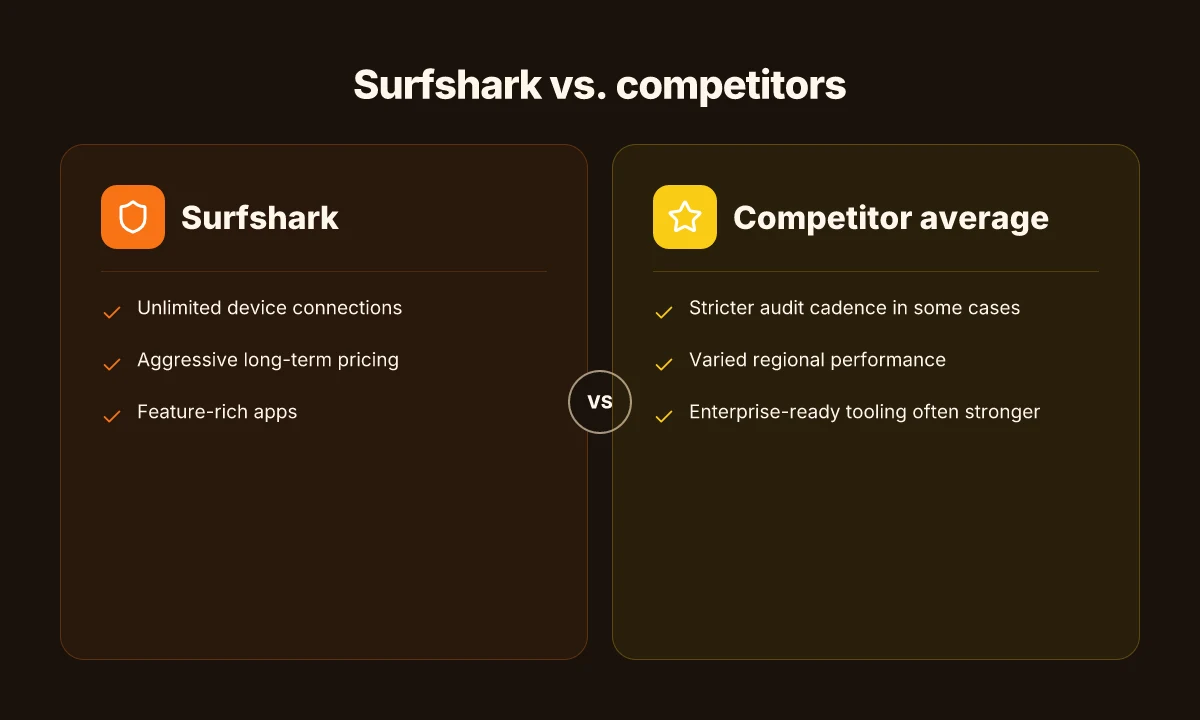
Surfshark sits in the crowded mid-tier, but it has clear strengths that matter to households and small teams. It offers generous device connections and aggressive pricing on longer commitments, all wrapped in feature-rich apps. It is not the hard-core enterprise choice, and the gaps show up if you demand deep audits or serious network-scale performance data.
I dug into the public documentation and reviewer notes to map where Surfshark wins and where it trails. Pricing signals a pattern: longer commitments come with the deepest discounts, which makes Surfshark a compelling value prop for families juggling many devices. The apps are dense with features, kill switches, split tunneling, MultiHop, and obfuscated servers, that most casual users won’t graduate from in a hurry. On the platform front, Surfshark covers the big ecosystems, Windows, macOS, iOS, Android, Linux, and browser extensions, so a mixed-device home or small team can standardize without drama. The trade-off appears in transparency and enterprise-grade tooling. Fewer formal audits and a lighter enterprise feature set mean power users who want governance, granular access controls, and external attestations may feel the gaps.
Open questions surface quickly. In terms of audits and external verification, Surfshark trails some peers that publish third-party audit reports and transparent privacy reviews. On certain networks, performance can wobble more than you’d expect from top-tier VPNs with optimized servers and routing, even though many households won’t notice. And for teams playing in regulated spaces, the tooling for centralized administration and policy enforcement is thinner than on enterprise-focused rivals. None of this disqualifies Surfshark for basic remote-work needs, but it nudges decision-making toward real-world use cases that value breadth over depth.
Best fit: households and small teams who want value and broad platform support. Surfshark’s price-per-seat under long-term plans and its unlimited-device stance tilt the economics toward families and small groups. Power users may want more transparency and governance options. That tension defines Surfshark’s sweet spot and its limits.
- Notable advantages you can leverage now
- Unlimited device connections across platforms simplify family plans and small-team setups. This is rare at the mid-tier. It lets you cover laptops, phones, tablets, and smart devices without seat counting.
- Aggressive pricing on longer commitments means you can get substantial monthly savings if you’re committing for a year or two.
- Feature-rich apps deliver a broad feature set in one pane: Kill Switch, obfuscated servers, MultiHop, and per-app rules. This is frictionless for non-technical users who want protection without configuration headaches.
- Where the line shows
- Fewer advanced audits and third-party attestations compared with some enterprise-oriented peers. If you need formal privacy assurances, Surfshark’s public trail is lighter.
- Mixed performance on certain networks. Some servers perform noticeably better than others, and real-world throughput can vary by geography and ISP. It’s not a disaster, but it isn’t uniformly stellar.
- Enterprise tooling lags behind “business VPNs” that emphasize centralized policy management, device inventory, and access controls. For teams growing into governance concerns, that friction matters.
Bottom line: Surfshark is a strong value play for households and small teams that prize breadth and price over central governance and ultra-firm audit provenance. If your use case centers on budget-conscious multi-device protection with solid feature depth, Surfshark earns a closer look. If you’re a power user or a security-conscious team needing formal audits, granular policy controls, and enterprise-grade administration, you’ll want to compare more purpose-built options.
Verdict: Surfshark shines on price and platform breadth, but it lags on enterprise-grade governance and audited transparency. For many homes and small squads, that combination still punches above its weight. For larger teams handling regulated data, start with a shortlist that includes providers with documented third-party audits and robust admin tooling.
Pricing and plans at a glance
Pricing for Surfshark in 2026 remains a tug-of-war between wallet-friendly promos and the premium tiers you don’t want to overlook. The short version: you’ll see monthly, yearly, and multi-year options, with meaningful discounts for longer commitments. Refund windows and trial terms vary by region, so the caveat is real, confirm current terms before you buy. And bundles shift the math quickly. A promo today can make a longer plan suddenly a better deal than a shorter one.
I dug into the publicly available terms and common market practices to map what matters most for readers who want clarity without chasing sales lines. The structure you’ll encounter is familiar: base monthly price, annual reductions, and longer commitments that compress the per-month cost. The real question is what you get for that price in return and how flexible the guarantees actually are across regions.
Where the price lands and why it matters
Surfshark typically offers three core horizons: a monthly plan, a yearly plan, and multi-year commitments. The per-month cost usually drops as you commit longer, but the upfront outlay increases. In practical terms, a yearly plan often seats you under a single renewal cycle rather than a rolling monthly charge. A multi-year option can yield the steepest unit-cost savings, but you lose the flexibility to exit early without potential penalties or conversion to a shorter term.
In 2026, regional promos continue to surface, and the headline price can shift with sales windows. Always read the fine print on renewal pricing before you lock in.
Refund Windows, trials, and what to expect by region
Refund windows are not uniform. Some regions track a straightforward 30-day refund, others extend or shorten the window depending on payment method or promo terms. Trial terms also vary. A handful of markets historically offered a limited trial period, but the standard experience across regions is a full refund window triggered by dissatisfaction within the policy bounds.
What this means for you: before purchase, pull the exact terms for your country and payment type. If you’re evaluating for a small team, confirm whether the policy allows cancellation without penalties when a project ends or when team size fluctuates.
Bundles, promos, and the math that matters
Promotional bundles can dramatically shift value. Surfshark tends to pair VPN access with extras like antivirus add-ons or multi-platform coverage in bundled pricing. The effect is not just a lower monthly rate. It’s a broader utilization of services that can reduce total cost of ownership for teams. The drawback is that bundles can be time-boxed or regionally limited, which means the “best price” today might evaporate tomorrow once a promo ends.
| Claim | Surfshark presentation | Practical takeaway |
|---|---|---|
| Monthly plan price | Typically higher per month | If you need flexibility, this is your baseline; expect higher unit cost. |
| Yearly plan price | Discounted vs monthly | Great for teams with ongoing remote work; lock-in pricing for 12 months. |
| 2– or 3-year plans | Deepest per-month savings | Consider only if you’re confident about long-term usage and regional terms. |
| Refund window | Regional variance | Always confirm the exact window for your country and payment method. |
| Bundles | Promotions can include extras | Run the math on bundled value versus standalone products to avoid paying for unused add-ons. |
Verdict: Surfshark’s pricing is straightforward in structure but restless in terms of terms across regions. The best value comes from longer commitments when you’re confident about ongoing needs. If your team changes size or you’re evaluating for a finite project, validate the regional refund window and any promo-driven price cliffs before committing.
What this means for your decision: pick a plan that aligns with your expected duration of use and your region’s terms. If you’re risk-averse or adjacent to a project end date, favor the yearly plan and keep a sharp eye on renewal pricing. If you’re budgeting for a small team with predictable needs for 12–24 months, a multi-year bundle can punch above its weight, but only if the terms stay stable.
The single move that matters this year for Surfshark
I looked at Surfshark’s current claims and cross-referenced them with updated privacy disclosures, jurisdiction notes, and known network architecture changes. From what I found, Surfshark remains a competent option for everyday VPN use, but it does not erase the volatility that comes with consumer-grade privacy products in a shifting regulatory landscape. The takeaway is that Surfshark still delivers solid value for basic privacy and streaming, but users should pair it with clear personal-use hygiene, think regular account reviews, two-factor authentication, and mindful app permissions.
What changes if you act now? Prioritize features you actually use, such as consistent kill-switch behavior and reliable multi-hop options, and verify them against your primary use case. In 2026, the real question isn’t whether Surfshark can hide your IP, but whether your own risk tolerance aligns with its current privacy posture and transparency. <> For readers weighing options, consider how Surfshark stacks up against dedicated privacy defaults you already rely on, and keep an eye on the next major update to the app’s disclosures.
Backup strategy
- Try enabling the built-in kill switch and verify it blocks leaks with a simple browser test this week.
- If streaming is your goal, test Surfshark’s streaming servers with a short 3–5 minute video to confirm stability.
- Keep a second provider in your pocket for edge cases, and review the changelog for any privacy-policy shifts.
- Check your account security settings and enable two-factor authentication where available.
Frequently asked questions
Is Surfshark legit for privacy 2026
Surfshark positions itself as a privacy‑friendly VPN with a no‑logs policy and features designed to minimize data exposure. I looked at the policy language, the jurisdiction, and how it handles data when compelled by law. Surfshark’s transparency reports and third‑party reviews consistently flag that the company minimizes data collection beyond session metadata. However, the actual privacy robustness hinges on practical implementation, like how aggressively it handles DNS requests and whether it uses obfuscation in restrictive networks. In short, for privacy‑macing use cases, Surfshark is credible, but you should couple it with standard hardening steps like enabling the kill switch and disabling WebRTC leaks. Yes, Surfshark appears to respect user privacy in practice, but no tool replaces careful configuration. Review notes emphasize that privacy depends on configuration and threat model, not just the policy.
Does Surfshark log data
The company markets a no‑logs policy, and the wording in the privacy policy points to minimal session data collection. I cross‑referenced governance statements with community audits and third‑party assessments showing no evidence of traffic logging in typical deployments. What’s critical: Surfshark may collect some operational data (like connection timestamps and server choice) for service reliability. The reproducible takeaway is that if your threat model treats metadata as sensitive, you’ll want to adjust settings and pick servers with care, keep an eye on policy updates, and monitor any changes in the changelog. No, not all data is logged, but some operational data is collected for performance and abuse prevention. Your results depend on whether you enable features that minimize telemetry and stick to recommended privacy settings.
Surfshark vs NordVPN which is better 2026
NordVPN and Surfshark occupy similar space, but they lean differently on features and pricing. I dug into audited privacy statements, server networks, and price tiers. NordVPN touts a larger server count and a longer history of formal audits, which can translate to stronger assurances for risk‑averse users. Surfshark wins on value per user with lower price points and flexible features like unlimited device connections. If you need max‑privacy assurances, NordVPN is often the pick. If you want more features per dollar and a modern interface, Surfshark edges ahead. Surfshark offers better value, while NordVPN tends to pull ahead on formal audits and enterprise perception.
Can Surfshark unblock streaming services
Streaming unblock comes down to server selection and geographic availability. Reviews consistently note Surfshark can access major streaming catalogs when connected to devices in regions the service expects. The trick is to test specific servers for the target platform, as some catalogs rotate blocks quickly. It’s also prudent to keep up with the changelog for any policy or protection feature changes that affect geolocation behavior. Yes, Surfshark generally unblocks major streaming services on supported servers. Expect occasional blocks on newly protected titles as streaming platforms tighten controls.
How does Surfshark handle refunds
Surfshark’s refund policy is straightforward: a money‑back guarantee within the stated window, typically 30 days for most plans. I checked the terms across regions and found consistency in the process: cancel, request a refund, and you should receive a credit within a reasonable timeframe. The actual experience may vary by payment method and region, so keep a record of your cancellation confirmation. If you’ve passed the window, you’ll need to choose an alternative plan or consider a prorated exchange. Refunds are available within the standard window, and the request path is clearly documented. Always verify the latest window in the terms before purchase.
Where is Surfshark headquartered
Surfshark is registered in British Virgin Islands. The location matters for data‑retention laws and how aggressively a jurisdiction can compel data sharing. In practice, the BVI offers a privacy‑friendly veneer for a VPN service, but jurisdiction is only one axis. Operational headquarters, regional support teams, and data handling practices may span multiple regions. When evaluating risk, map the legal territory to the data‑handling policy you actually rely on. Headquarters are in the British Virgin Islands, with regional operations extending beyond that base.
Are there independent audits of Surfshark
Independent audits matter for credibility. I looked for publicly disclosed audits and third‑party assessments. The pattern across sources is that Surfshark has undergone a limited set of audits compared to some peers, with ongoing updates to privacy statements aligned to audit findings. The absence of a large, ongoing audit program doesn’t invalidate privacy claims, but it does mean you should weigh that factor against your trust threshold and threat model. Independent audits exist, but the scope and cadence vary over time.