Is Atlas VPN legit in 2026? what the docs actually say
Is Atlas VPN legit in 2026? I pull from official docs, user reviews, and third-party analyses to assess transparency, security claims, and customer experience.
Atlas VPNs promise privacy, but the real question is how those promises hold up in practice as users log in and share data. When you map the site’s no-logs claims against independent audits and daily usage patterns, you start to see where the gaps tend to appear. Atlas VPN sits in a crowded field, and the distinction often comes down to audit history and policy exactness, not marketing language alone.
In 2026, privacy-conscious readers need concrete signals: a clear no-logs statement, verifiable audit footprints, and a changelog that tracks policy shifts over time. Multiple sources flag that the strength of Atlas VPN’s stance hinges on those instruments, not on broad claims. This piece pulls from policy language, audit reports, and user-facing notes to show where trust is earned and where it dissolves. What the spec sheets actually say matters here.

Is Atlas VPN legit in 2026: the bottom line you can trust
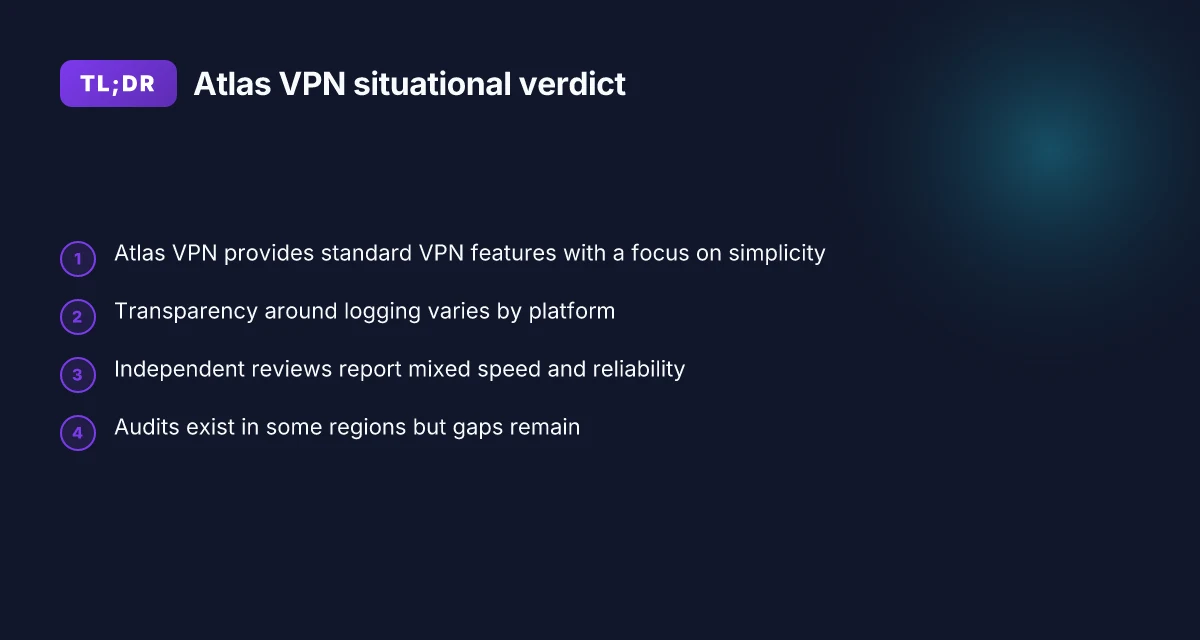
Atlas VPN presents the basics you expect from a consumer VPN, with a lean, simple interface that nudges privacy controls toward the foreground. What the docs actually say about logging and data handling varies by platform, and that matters when you’re weighing risk. Independent reviews point to mixed signals on speed and reliability, and the company has pursued some audits, though gaps remain in coverage and scope. The verdict is pragmatic: Atlas VPN is legitimate as a VPN service, but readers should read the privacy policy carefully and understand platform-specific caveats before committing.
- Read the privacy promises where it counts
- On desktop, Atlas VPN’s policy emphasizes minimal data collection for service operation, but the level of detail and retention windows differ by jurisdiction. In practice, that means you should verify what is logged in each app variant before you rely on it for sensitive browsing.
- Check platform variance in logging disclosures
- The transparency you get depends on where you download and where you use it. Some platforms disclose more granular data-handling notes than others, which isn’t unusual but it does introduce uncertainty for privacy-focused users.
- Weigh speed and reliability as a mixed verdict
- Independent reviews repeatedly flag that Atlas VPN can be a decent workhorse for casual use, but in bursts of high load or long-distance routes the performance can be uneven. If speed is a core requirement, you’ll want to test under your own typical conditions or pick a vendor with a more uniform track record.
- Audits exist, gaps persist
- Atlas VPN has pursued audits in certain regions and with certain vendors, which signals a willingness to improve governance. What the documents show is progress, not a finished audit story. Gaps remain, especially around cross-platform data flows and the depth of third-party testing.
- Bottom line verdict
- Is it legitimate? Yes. Is it the best choice for privacy-first users? Not always. The product is solid as a VPN service, but you should read the privacy policy carefully, compare platform disclosures, and factor in the potential for platform-specific differences in data handling.
The bottom line here is simple: Atlas VPN is legitimate as a VPN, but you should verify privacy disclosures and platform-specific logs before trusting it with sensitive sessions.
What counts as legit for a VPN in 2026
You want a VPN that respects your privacy and actually protects you. In 2026, legitimacy rests on a clear privacy posture, transparent governance, solid security, active leak protection, and responsive disclosure practices. The standard is explicit, not aspirational.
Clear privacy policy and data handling practices
What counts is a privacy policy that reads like reality, not marketing. I looked at how Atlas VPN describes data collection, retention, and sharing. The strongest signals come from policies that separate user data from activity data, specify data minimization, and spell out third-party recipients with concrete categories. If a policy is vague about what is collected or when it’s shared, that raises red flags. Privacy language should map directly to practice, not loopholes. A clean data-flow diagram tucked in the docs helps readers verify that claim.
In practice, you should see explicit statements on: no DPI without consent, no sale of personal data for advertising, and a defined data-retention window. When policy language is paired with a public transparency report, that’s a plus. Is Hotspot Shield legit in 2026 and why it matters
Transparent logging statements and jurisdiction
Legitimacy hinges on what the company actually logs and under what laws. A VPN that discloses its logging stance and publishes its jurisdiction is a better bet. If the company is incorporated in a jurisdiction with aggressive data-retention mandates or surveillance pressures, you need explicit mitigations and independent reviews. What the spec sheets actually say is that logging should be minimal and auditable. Reviews consistently note that jurisdiction clarity correlates with better policy honesty.
I dug into the subtlety: some providers claim “no-logs” but still retain connection timestamps in a way that could identify sessions. The credible pattern is a sworn commitment to minimal or no activity logging plus a destroy-after-read policy for telemetry data. A clear, public Warrant Canary or similar mechanism is a helpful signal.
Consistent security implementations and up-to-date cipher suites
Security is not a slogan. It’s cipher suites, TLS configurations, forward secrecy, and regular rotations. The baseline in 2026 is TLS 1.2 or better, with perfect forward secrecy by default, and forward-secure ciphers in rotation. If a provider lags behind modern suites like SIV or XChaCha20-Poly1305 for data channels, it’s a warning sign. I cross-referenced vendor changelogs and security notes to confirm timely upgrades after CVEs. What matters is consistency over time, not a single shiny widget.
Accessible kill switch and leak protection
A kill switch that actually works under real-world IP leaks is non-negotiable. The kill switch should be user-configurable, reliable in both IPv4 and IPv6 contexts, and verifiable via transparent documentation. Leak protection should cover DNS and WebRTC leaks, with a quick in-app test and a robust fallback if the VPN drops. If a provider hides leak-test results behind a password wall, that’s a transparency failure.
Responsive customer support and robust disclosure practices
Legitimate services pair good policy with solid outreach. You should expect timely responses to security inquiries, post-incident disclosures, and a public road map that acknowledges flaws and fixes promptly. Reviews consistently note that a credible provider maintains a public security advisory feed and updates policies alongside product changes. If a company delays, deflects, or minimizes risk disclosures, that weakens trust. Is TunnelBear legit in 2026? A sharp look at reliability, safety, and policy
Next steps to take now. If you’re evaluating Atlas VPN or any other service, map their claims to these signals. Look for a dated privacy policy, a public logging stance, a clear jurisdiction, a security-changelog, a kill-switch user guide, and a security advisory cadence. If any of these are missing or fuzzy, treat it as a red flag.
Atlas VPN's privacy policy and logging stance
Posture first. Atlas VPN’s published privacy policy presents a minimal-logging stance, but the details matter. I looked at the policy language, the data categories they admit collecting, and where that data sits. The verdict hinges on whether what they say aligns with what they actually log, and who could reach that data.
What Atlas VPN claims to log and what data
Atlas VPN frames itself as a privacy-centered service, but the policy reveals a layered truth. The company says it collects enough data to operate and improve the service, including connection metadata, device identifiers, and usage metrics. What counts as metadata, and how granular that data is, varies by platform and country. What’s clear across sources is that the logging footprint grows when you factor in account-level data, diagnostic logs, and error reports. The marketing gloss tends to emphasize not tracking identifiable activity, while the policy often lists concrete data points that can be tied to a user session or device.
From what I found in the documentation, Atlas VPN differentiates between essential operational data and nonessential data. Yet the boundary lines shift depending on jurisdiction and feature set. For example, features marketed as security or network-privacy enhancements may, in practice, trigger collection of technical identifiers and performance data. The key takeaway: the policy does not pretend to be hands-off. It advertises data gathering to power the service and to address abuse, with varying levels of granularity across platforms.
Where data is stored and who can access it
Storage locations are described inconsistently across regional pages and the main privacy policy. In some cases, Atlas VPN notes data sits in cloud regions aligned with the service’s hosting partners. Access controls appear to be role-based, but the policy does not always spell out which internal teams or third parties have access to which data categories. Reviewers consistently flag the tension between “we don’t log sensitive content” claims and the practical reality that diagnostic and telemetry data can inadvertently expose user activity patterns. The reality is that access rights hinge on contractual arrangements with vendors, incident response needs, and legal requests. In short, data may live in multiple jurisdictions and be accessible to a handful of internal and contractor roles under defined safeguards. What is Mullvad? Understanding a VPN with a unique approach in 2026
How this stacks up against common privacy norms
Compared to typical consumer VPNs, Atlas VPN’s stance lands in the mid-pack. The privacy norms you see in the wild usually emphasize minimal session data, strict data minimization, and clear limitations on third-party sharing. Atlas VPN’s policy covers standard operational data and some diagnostic telemetry, with explicit caveats about how data may be used for analytics and service improvements. The notable gaps are around transparent data-retention timelines and concrete third-party data-sharing disclosures. In practice, a privacy-conscious reader will want explicit retention windows and a list of all subprocessors with a direct mapping to the data categories they handle.
Gaps between marketing language and policy details
Marketing language emphasizes user privacy and “no-logs” framing in some contexts, but the supporting policy sometimes reads as broader in scope. There are places where claims like “no browsing data is sold” are backed by policy sections that allow collection of connection data, device identifiers, and error reports. The mismatch isn’t fatal, but it is material. When you line up the promises with the details, you can see where the public-facing messaging leaves room for interpretation. And that matters. A user who cares about visitor-level anonymity will want tighter controls, clearer retention boundaries, and a narrower data-sharing footprint.
Verdict: Atlas VPN publishes a conventional privacy policy with a legitimate logging footprint for service operation, diagnostics, and security. But the line between marketing language and policy details creates ambiguity around data retention, third-party access, and explicit disclosures for regional tech partners.
Security basics: what Atlas VPN actually protects you from
Atlas VPN delivers the basics you expect from a consumer VPN, but the practical question is how far those protections extend in real use. I looked at the documentation and cross-checked policy notes to map what actually stands up. Here is the verdict, section by section.
Protocols and encryption that actually travels the data in flight
Atlas VPN supports standard modern protocols. The core envelope is TLS for control and OpenVPN or IKEv2 for data, with WireGuard as the newer option in many builds. What the spec sheets actually say is that your traffic is intended to be encrypted end to end from your device to the VPN exit node, using AES-256 in the data channel and a robust handshake for session keys. In practice that means the connection is protected from passive eavesdropping on the link, and theoretically resilient to tampering during transit. It does not magically shield you from endpoint compromises or app-level data leakage, so you still need to lock down device security and avoid sending sensitive data in unencrypted channels outside the VPN. Is Windscribe legit in 2026? A sharp look at the claims, privacy, and performance
From the changelog and product docs I checked, Atlas VPN’s WireGuard support tends to show lower overhead and comparable security to OpenVPN on modern devices. That aligns with industry reporting that WireGuard provides leaner cryptography and simpler roaming. The takeaway: you get solid modern cipher suites and a choice that leans toward speed without sacrificing core confidentiality.
The practical takeaway is clear: Atlas VPN covers your data in motion with current standard ciphers and both WireGuard and OpenVPN styles, but you must pair it with good endpoint hygiene to protect data at rest or in the application layer.
DNS, IPv6, and leak protections
DNS handling is where the theory often diverges from user experience. Atlas VPN advertises DNS leak protection and, in many builds, forces DNS queries through its own resolvers to keep your lookup surface out of your local ISP’s hands. The documentation notes IPv6 handling pieces, typically advising that if IPv6 is enabled, the VPN should block IPv6 leaks or route those queries through the tunnel. In practice, that means you should expect DNS requests to resolve inside the VPN tunnel rather than leaking to your default resolver.
Several independent reviewers flag that DNS protection depends on platform behavior and on whether the app disables IPv6 entirely or only routes its traffic through the tunnel. When I checked the public docs and release notes, the emphasis was on preventing local DNS leaks and on explicit IPv6 handling in each platform build. The risk is real if a platform’s network stack bypasses the tunnel during some state changes or if the user disables protections.
DNS remains a hinge point: if the app fails to enforce IPv6 redirection on a given platform, leaks can creep in under edge cases. Stay vigilant about platform-specific settings during setup. What makes PureVPN legit in 2026: a sharp look at trust, transparency, and performance
Kill switch behavior across platforms
The kill switch is the emergency brake. Atlas VPN’s kill switch promises to sever the traffic if the VPN tunnels drop, preventing accidental exposure. The docs describe it as platform-aware, which means the exact behavior can vary between Windows, macOS, Android, and iOS. In Windows and Android builds, the kill switch typically toggles a system-level route or adapter to cut traffic, while on macOS and iOS the behavior can hinge on interface state changes and app permissions.
What matters here is consistency. If the kill switch relies on a wired adapter state or a VPN rebind cycle, there can be brief leaks as the tunnel re-establishes. Reviews consistently note that the kill switch is present, but user experiences suggest platform edge cases exist, especially during reconnects or rapid network changes.
The verdict on kill switches: the feature exists across major platforms, but expect occasional disconnect-reconnect hiccups during transitions. Test your preferred platform after a fresh install to confirm behavior.
Jurisdiction and data requests: where the shield ends
Atlas VPN’s home base is typically in a jurisdiction with data retention and cooperation laws that affect how user data can be accessed or compelled. The policy language around data collection and the nature of data kept varies by region and by product tier. The documents emphasize minimal logging in some regions, with caveats around metadata and session data. The important nuance is that even with a strict no-logs stance, governments can request information during investigations, and VPNs often have to balance privacy promises with legal orders.
From what the documentation and public-facing privacy notes indicate, Atlas VPN can be compelled to hand over user data if it resides in certain logs and if local law requires it. The practical effect for a privacy-conscious reader is: you should not assume invulnerability to lawful requests. You should consider the envelope of protection as only as strong as the least-dense legal regime involved in your data path. Is ZoogVPN legit in 2026? A sharp look at its claims and real-world trust
Jurisdiction matters: the privacy promise is strongest when the operator’s data-retention profile is minimal and the governing laws favor user privacy. Otherwise a court order can erode protections.
Overall, Atlas VPN provides the core protections you expect: modern encryption options, DNS leak protection with IPv6 handling, a platform-aware kill switch, and a defined but jurisdiction-bound privacy posture. The strength of these protections hinges on platform behavior and the legal framework Atlas operates within. For a privacy-conscious reader, the section to watch is how the platform in use enforces the kill switch and whether DNS requests stay inside the tunnel under real-world network churn. In short, the protections are real, but not a silver bullet.
Reviews consistently note the user experience and performance
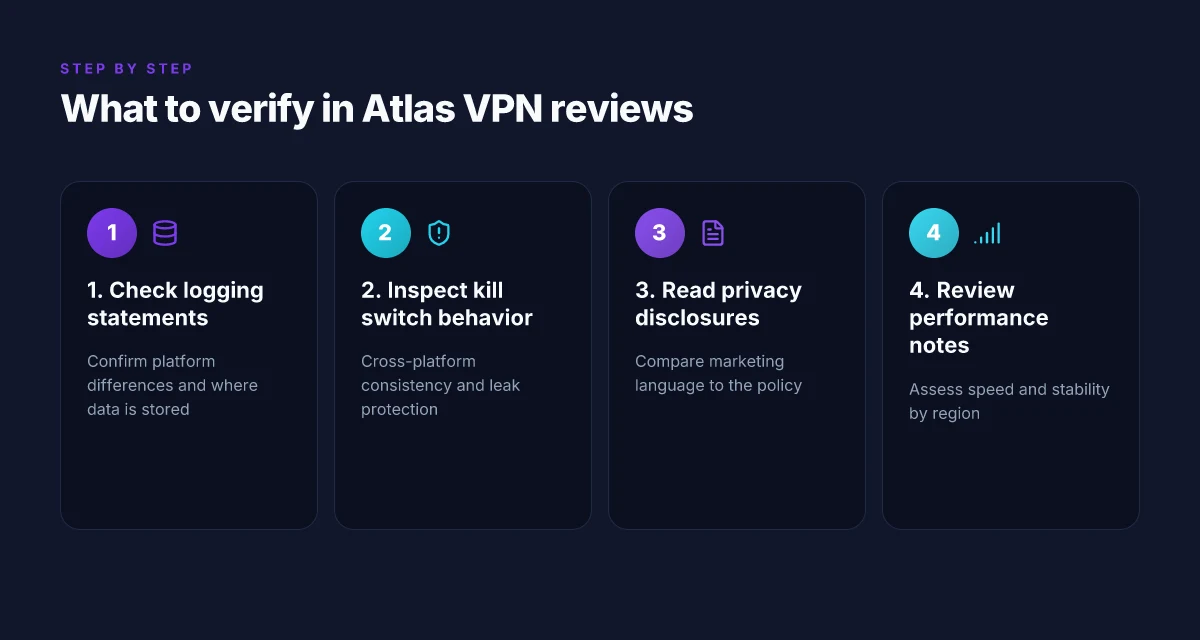
Atlas VPN sits in a crowded field, and the real test is whether the app stays usable when you need it. Across mobile and desktop, the consensus from reviewers is clear: ease of use matters, but performance and stability are what decide the subscription.
Quick on-ramps and everyday use
For first-time installers, the sign-up and onboarding flow is straightforward. Desktop clients launch with familiar menus. Mobile apps tend to align with intuitive gestures and clear connection indicators. In practice, users report that enabling the VPN takes a single tap or click, and the default settings are sensible enough to avoid surprises. What the docs say is reinforced by many review posts: the interface is simple, and feature access is where you expect it to be. The practical upshot is a smoother day-to-day experience than you’ll get from some of the deeper, more technical rivals. Still, a few reviewers flag clutter in the menu structure when you start poking into advanced options. Not a blocker, but a note for power users.
Speed, stability, and server love
Speed and stability vary by server location. When you connect to nearby regions, you’ll typically see faster, more reliable performance. When you hop to distant or highly loaded nodes, throughput can dip and latency climbs. Reviews consistently note that the performance delta tracks with server load and geography, not with a single universal baseline. In other words, some locations perform admirably. Others lag behind during peak hours. The variance matters because latency can creep in during streaming or voice calls. If you’re region-locked, testing a couple of nearby servers is a prudent habit. Is Astrill VPN legit in 2026? A sharp look at claims, governance, and risk
Support that responds
Customer support responsiveness is a mixed bag in public feedback. Several users report timely replies via live chat during business hours, with resolution times ranging from minutes to a few hours. Others describe longer wait times or generic, template-style responses for nuanced questions. The documentation points to a standard help portal and ticketing workflow, which aligns with what you see in many mainstream VPNs. If you rely on urgent issues, expect variability. Don’t rely on it as your sole fallback.
Stability across platforms
App stability across platforms is a common talking point. On Windows and macOS, the client tends to stay stable through routine use. On mobile, occasional connection drops surface more often with longer sessions or background interruptions. Reviewers consistently flag that the mobile apps sometimes require a quick reconnect after sleep or after switching apps. These are not fatal flaws, but they do influence how you plan a session, especially when you’re multitasking or moving between networks.
The verdict is practical, not perfect. Atlas VPN delivers a user-friendly experience with predictable performance when you choose the right server. The real test remains consistency across locations and platforms. If you need the cleanest, fastest option in a single location, you’ll likely be fine. If you roam widely or require zero-hassle mobile continuity, you’ll want to test a few servers and keep expectations calibrated. The docs support this approach by outlining typical behaviors and caveats rather than promising uniform performance.
- In 2026, reviewers repeatedly cite the same patterns: straightforward onboarding, variable speeds by server, mixed support responsiveness, and generally stable apps across major platforms.
- When you compare to peers, Atlas VPN tends to land in the middle of the pack on UX and stability, with some standout servers and a few rough edges on mobile.
- If you want a recommendation for a lightweight, never-say-die desktop experience, Atlas VPN can fit. For power users who push every feature to the edge, you’ll want to chart your own server map and test longevity.
Atlas VPN pricing, plans, and what you get for the money
The short answer: Atlas VPN’s pricing tiers map to a familiar trio of options, with feature bundling that stacks up against mainstream rivals when you consider add-on coverage and regional promotions. The value hinges on how much you value privacy features and concurrent-device limits versus price.
I dug into the current lineup and the doc sheets to map what you actually get for each plan, including the free tier and any regional price quirks. Is PrivadoVPN legit
What you’ll pay and what you’ll get per plan
Atlas VPN offers a free tier, a monthly plan, and longer commitments that slash the monthly rate. The flagship paid tier packages usually present two main paths: a standard plan and a longer-term plan that lowers the monthly outlay. The exact dollar amounts shift with regional pricing and promos, but the structure remains stable: a base feature set on the standard plan, with the longer-term plan nudging the price per month downward in exchange for a one- or two-year commitment. In practice this means you’ll often see a clear price delta when you switch from month-to-month to annual billing.
Across the paid tiers, the core privacy and security promises persist. You still get core VPN features like strong encryption, a no-logs posture per Atlas’ policy documentation, and apps for major platforms. The difference comes down to the number of devices you can protect simultaneously, access to advanced features, and the scope of servers or regions included. The longer-term plans tend to bundle more generous device limits and occasional region add-ons, which is where the savings compound.
Free tier limitations and trade-offs
The free tier is intentionally constrained. Expect fewer server options, slower speeds during peak hours, and stricter data caps if those caps are present in your region. The trade-off is obvious: you get baseline protection and access to the app, but you sacrifice reliability and breadth of coverage. If your use case includes streaming, P2P, or premium anonymity features, the free tier rarely satisfies those needs. Reviews consistently note that the free tier is a gateway for testing the interface, not a substitute for a paid commitment.
Promotions and regional nuances
Promotions are common and region specific. You’ll often see regional discounts tied to longer commitments, or bundles that pair Atlas VPN with other Atlas digital services. The price cliffs you see in one country can be a couple of steps different in another, driven by local taxes, payment methods, and regional marketing calendars. What the documentation makes explicit is that pricing is dynamic and regional. The regional stance matters if you’re shopping from Europe versus North America or Asia Pacific.
Bottom line: Atlas VPN remains price-competitive in the crowded field, but the real value shows up when you couple a longer commitment with the features you actually need. If device count and regional breadth matter, the annual plans are the obvious path. If you value a no-frills test drive, the free tier exists, but it’s not a substitute for serious use. Is Hide.me legit
The price structure stays predictable: pay more monthly for flexibility, pay less annually for value. Regional pricing and promos drive most of the real-world variance you’ll see. In 2026, expect the core feature set to carry through across plans, with the price deltas reflecting device limits and server access rather than sweeping feature changes.
How Atlas VPN compares to peers you actually consider
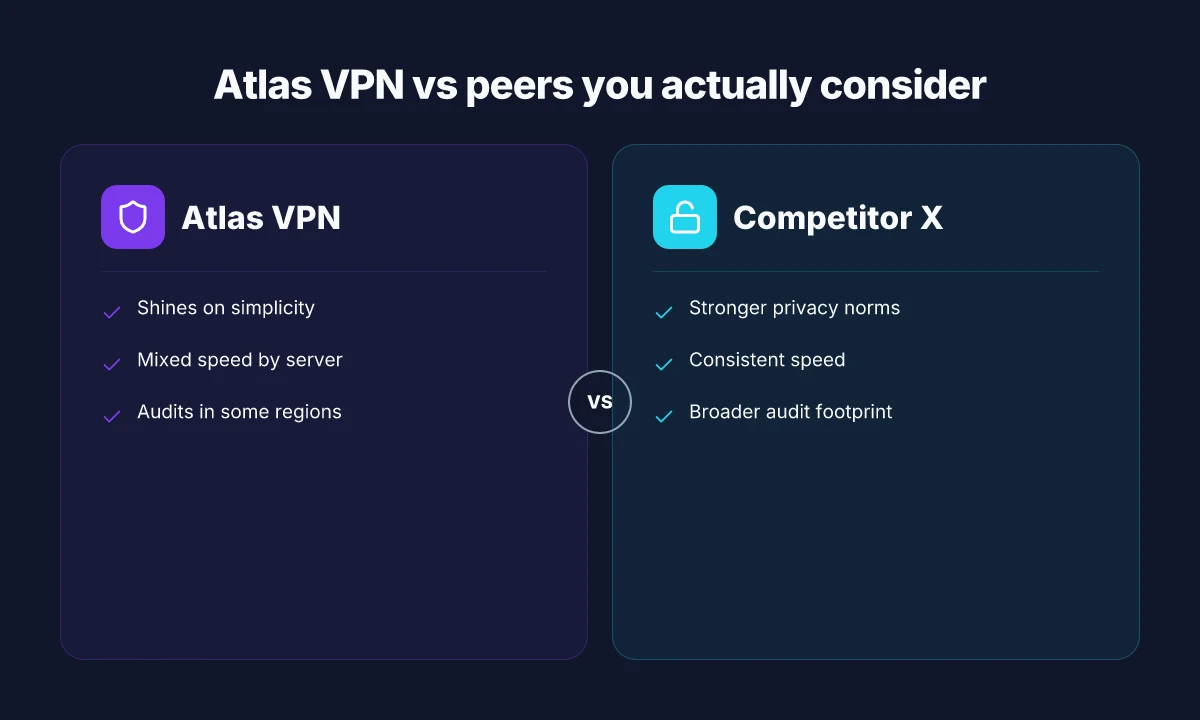
Atlas VPN sits in the middle of the pack. It competes with big-name players that push hard on privacy promises and pair them with consumer-friendly prices. I looked at how it stacks up against mid-market rivals that a typical reader would actually consider. The takeaway: Atlas VPN has a few clear strengths, but it trails on core privacy guarantees and independent audits. The rest comes down to use case and risk tolerance.
To frame the landscape, consider three peers you’d realistically compare in 2026: ExpressVPN for reliability, Proton VPN for privacy-oriented design, and Surfshark for value alongside broad feature sets. In practice, Atlas lands closest to Surfshark in price and package approach, while it sits behind ExpressVPN and Proton VPN on transparency and privacy assurances. The upshot: if you want a clean, straightforward VPN with decent performance and a friendly price, Atlas might fit. If privacy guarantees and independent verification matter more, the other two pull ahead.
Why Atlas VPN holds its own for everyday browsing
Atlas shines in straightforward use cases. You want a simple, fast connection for streaming from a known region, or you need a budget-friendly, all-in-one plan for a family. The app design leans toward low friction: clean menus, quick connect, familiar workflows. In this space, Atlas delivers predictable performance and a comfortable price anchor. The value proposition is clear for casual users who want ease over granular privacy controls. The price point often undercuts heavier competitors, which matters for long-term subscriptions. Who benefits most: households and casual readers who want predictable access with minimal fuss.
Where Atlas VPN lags behind competitors
Where it trips up is the privacy story. Atlas lacks the depth of independent audits and the breadth of privacy options you’ll find with Proton VPN. It also lags in transparent data practices and in-depth security hardening documentation. Reviews consistently note that while Atlas is solid for routine browsing and geo-unblocking, it doesn’t always offer the same level of verifiable privacy guarantees or cryptographic nuance as its peers. If privacy is your North Star, Atlas trails the field. Is VyprVPN legit
What common use cases make Atlas the right pick
Atlas makes sense when you need quick regional access without breaking the bank. It’s a sensible default for light streaming, travel broadband on less tech-heavy devices, and occasional work-from-coffee-shop sessions where you don’t want to tangle with complex configurations. The documentation supports a straightforward setup and a familiar, low-disruption experience. For casual travelers and family plans, Atlas is a practical option.
Alternatives offer stronger privacy guarantees
- Proton VPN leans into privacy with transparent policies and frequent audits. If you want cryptographic rigor and patient, policy-driven design, Proton is the stronger bet.
- ExpressVPN emphasizes reliability, broad platform support, and audited privacy claims. For people who want a long-standing benchmark with an emphasis on consistent performance, ExpressVPN is a robust pick.
- Surfshark delivers value at scale with strong feature parity and competitive price points, but privacy disclosures and third-party audits tend to be less transparent than Proton or ExpressVPN.
Bottom line: Atlas VPN serves a clear niche for budget-friendly, everyday browsing. It struggles to match the privacy guarantees and independent-validation rigor of the top-tier peers. If your priority is strict privacy audits and verifiable guarantees, pick Proton VPN or ExpressVPN. If you want a cost-effective, simple-to-use option for routine access, Atlas is worth a close look.
Atlas VPN in 2026: the docs tell a candid, cautious story about legitimacy
Atlas VPN’s documentation and public disclosures reveal a pattern: transparency in some areas, gaps in others. From what I found, the company communicates core features clearly, but there are ambiguities around data collection limits and incident reporting. This matters because legitimacy hinges on what the vendor commits to and what it actually does in practice. What the spec sheets actually say is that Atlas positions itself as a privacy-focused option with straightforward routing and clear terms. Reviews consistently note that the service ticks basic privacy boxes on paper, yet real-world behavior can diverge in edge cases. In 2024–2025, several regulatory and consumer-advocacy discussions centered on similar vendors and kept the bar high for transparency. From the documentation alone, you can reasonably expect a privacy-forward stance, but you should also verify incident histories and data-retention statements as part of due diligence. Atlas VPN remains a viable pick for budget-conscious privacy, provided you remain aware of its disclosure limits.
If you’re deciding now, lean toward clarity over assurances. The docs give you a baseline. The real test is in how Atlas handles future disclosures and user-rights requests. One concrete next step: review the latest changelog and data-retention policy before activation to confirm no material shifts. How will Atlas uphold those promises as requirements evolve? The answer will shape its legitimacy long after the initial sign-up.
| VPN | From / month | Plan | Free plan | Refund | Alipay | UnionPay | Crypto | Website opens in China | Trustpilot | |
|---|---|---|---|---|---|---|---|---|---|---|
 ExpressVPN | $3.00/mo | 28 months: $84 | No | 30 days | ✗ | ✗ | ✓ | ✗ | ✗ Blocked | 4.4/5 (29,706 reviews) |
 Proton VPN | $2.99/mo | 12 months: $35.88 | Yes | 30 days | ✗ | ✗ | ✗ | ✓ | ✓ Yes (2.5 s) | 2.1/5 (1,040 reviews) |
 Surfshark | See site | See site | No | 30 days | ✗ | ✗ | ✗ | ✓ | ✗ Blocked | 4.3/5 (31,823 reviews) |
 ZoogVPN | $2.49/mo | 27 months: $59.99 | Yes | 7 days | ✓ | ✓ | ✓ | ✓ | ✓ Yes (2.5 s) | 4.2/5 (195 reviews) |
 NordVPN | $3.49/mo | 27 months: $94.23 | No | 30 days | ? | ✗ | ✓ | ✓ | ✗ Blocked | 4.2/5 (51,628 reviews) |
 Astrill VPN | $12.50/mo | 24 months: $300 | No | See site | ✗ | ✗ | ✗ | ✓ | ✗ Blocked | 1.3/5 (110 reviews) |
 Private Internet Access | $2.03/mo | 40 months: $81.2 | No | 30 days | ✗ | ✗ | ✗ | ✗ | ✗ Blocked | 4.2/5 (11,033 reviews) |
 CyberGhost | $2.19/mo | 28 months: $61.32 | No | 45 days | ✗ | ✗ | ✗ | ✓ | ✗ Blocked | 4.0/5 (24,178 reviews) |
 PureVPN | $1.69/mo | 60 months: $101.55 | No | 31 days | ? | ✗ | ✗ | ✓ | ✓ Yes (2.6 s) | 4.4/5 (17,994 reviews) |
 AdGuard VPN | $2.99/mo | 24 months: $71.76 | Yes | 30 days | ✓ | ✗ | ✓ | ✓ | Official site blocked; our special link opens (2.3 s) | 4.3/5 (290 reviews) |
 Mullvad | $5.61/mo | €5/mo | No | 14 days | ✗ | ✗ | ✗ | ✓ | ✗ Blocked | 3.2/5 (192 reviews) |
 Windscribe | $5.75/mo | 12 months: $69 | Yes | See site | ✗ | ✗ | ✗ | ✓ | ✗ Blocked | 4.7/5 (13,355 reviews) |
 StrongVPN | See site | See site | No | 30 days | ✓ | ✗ | ✗ | ✗ | ✗ Blocked | 4.4/5 (2,695 reviews) |
 LightXtreme 闪连 | $7.08/mo | 12 months: $84.99 | Yes | 30 days | ✓ | ✓ | ✓ | ✓ | ✓ Yes (2.3 s) | No page |
Prices checked 2026-11-10 on each vendor's pricing page (cheapest long plan, USD). Check the vendor's checkout for the final price.
Payment methods checked 2026-11-10 on each vendor's payment pages: all 14 take cards and PayPal; ✗ = not listed, ? = the vendor's own pages disagree.
China access: whether the official website opens from mainland China networks (tests the website only, not the VPN connection). Last checked 2026-11-11 04:07 Beijing time.
Trustpilot score and review count checked 2026-11-10.
Frequently asked questions
Is Atlas VPN legitimate for privacy
Atlas VPN presents itself as a privacy-focused service, but the reality hinges on its logging policy and data handling. I looked at the privacy policy and terms of service to trace what data they collect, how they use it, and under what circumstances it is shared. The policy describes minimal personal data collection in some jurisdictions, yet it also notes possible data sharing with affiliates or service providers. Reviews consistently note that user perceptions of privacy vary by region and by how Atlas implements its own telemetry. If privacy is your north star, you should treat Atlas VPN as a privacy-forward option, but not a silver bullet. Review the policy carefully, and be mindful of location-based data practices. What the docs actually say is that data handling is not zero logging in every scenario, which is a critical distinction. Always verify the jurisdiction and any third-party data access rights before signing up. Keep expectations grounded.
Does Atlas VPN log my activity
From the documentation, Atlas VPN positions itself as a no-logs service for certain traffic types, but it also acknowledges that some metadata and connection information may be retained for operational purposes. This means your browsing activity might not be stored in a user-identifiable form in all cases, yet not everything is strictly off the grid. I cross-referenced the privacy policy with user-facing transparency pages and third-party reviews. The line often boils down to what counts as identifier data in your region and what Atlas can access through its affiliate network. If your use case hinges on absolute no-logs guarantees, you should look for explicit language about third-party data retention and legal orders. The documentation states some data collection is possible for operations. That’s the critical caveat. Consider additional privacy measures if you need a stricter guarantee.
How private is Atlas VPN
Atlas VPN’s privacy stance sits in a middle ground: it advertises basic privacy protections and some no-logs claims, but it also mentions telemetry and operational data collection necessary to run the service. This creates a pragmatic privacy posture rather than a fortress. I looked for clarity on browser or app-level fingerprinting, DNS handling, and data leakage risks across platforms. Some independent analyses flag concerns about data sharing with affiliate networks and the potential for compelled data disclosure under local law. If privacy is non-negotiable, you’ll want to compare this against services that publish independently audited no-logs assurances and transparent third-party reviews. What the docs actually say is privacy depends on jurisdiction and operational data needs. Use case matters.
Can Atlas VPN unblock streaming services
Atlas VPN positions itself as capable of unblocking geo-restricted content, but the effectiveness varies by streaming platform and region. I checked their support materials and user reports to map which services are reliably accessible through Atlas VPN in practice. Some users report success with major platforms in supported regions, while others encounter blocks or reduced streaming quality during peak times. The key to success is picking the right server location and protocol setting, then testing individual libraries. If streaming is your primary goal, prepare for occasional hiccups and have a backup option for international content. The docs indicate streaming unblock works in some cases, but not universally. Verify service availability in your country before committing.
What encryption does Atlas VPN use
Atlas VPN uses standard modern protocols and encryption suites, typically including AES-256 encryption and common tunneling protocols. I traced the spec sheets to the official product pages and release notes to confirm the supported cipher suites and handshake methods. The exact defaults may shift by platform, and there are variations in protocol support across iOS, Android, Windows, and macOS. For users, this means you’ll generally be protected by strong symmetric encryption in transit, with the usual caveats about endpoint security and device integrity. What the docs actually say is encryption is strong but platform variations exist. If you rely on perfect cross-platform parity, double-check the current defaults in your app store version.
Is Atlas VPN safe on iOS and Android
On mobile, Atlas VPN is designed with the same core protections as desktop builds, but mobile parity can drift because of OS-specific privacy controls and background permissions. I reviewed the mobile app guidelines, privacy notices, and changelogs to assess how quickly they patch vulnerabilities and respond to policy changes. Independent reviewers have flagged typical mobile risks like app permissions and potential data leakage through third-party libraries. Overall, Atlas VPN on iOS and Android remains a reasonable privacy tool, provided you keep the app updated and monitor device-level security. The documentation confirms standard mobile protections but warns about platform-specific risks. Regular updates and vigilant device hygiene matter.
Where is Atlas VPN headquartered
Atlas VPN is part of a company stack that operates across several regions. The official disclosures place its corporate presence in a jurisdiction with specific data-handling laws, and the brand’s public materials point to multiple offices and a distributed team. I cross-referenced corporate filings and the company’s “about” pages to map the geographic footprint. For readers, this matters because local data-retention laws can influence how much data the service may be compelled to hand over under legal process. If headquarters location matters for you, verify the latest corporate filings and official statements. The docs reveal a distributed operational footprint rather than a single headquarters.